Contents
History & evolution
Origins & pre-professional era
The roots of organised football in Japan go back to the Japan Soccer League (JSL), which was founded in 1965. It was the country’s top league and was semi-professional, meaning the players were company employees. By the 1980s, the league was struggling with low attendance and poor results from the national team, which led to a push for a professional league.
Founding of the J.League (1992-1993)
The professional J.League was established in 1992 and officially kicked off its first season in 1993. The league started with 10 clubs, eight of which came from the JSL, one from the second division, and one newly formed club. In its early years, the season was split into two stages, with the winners of each half playing a championship final.
Format changes over time
The league’s format has changed several times. In 1999, a second division, J2, was introduced, and the number of teams in the top flight was adjusted. In 2005, the league moved to a single-season format, similar to those in Europe. The promotion and relegation system also changed over the years, from direct relegation to play-offs and then back again.
Modern era (2009 to present)
The modern era of the J.League has seen a lot of growth. The number of clubs has increased, and the league has become more important in international competitions like the AFC Champions League and the Club World Cup. New rules were also brought in to allow more foreign players, which has raised the quality of the league.
Upcoming / recent changes
In a big upcoming change, the J.League will switch its season calendar to the European style, running from autumn to spring, starting in the 2026-27 season. The number of clubs has also recently changed, with the league having a total of 20 teams.
Milestones & notable events
– First J.League match: The first-ever J.League match was played on 15 May 1993, between Verdy Kawasaki and Yokohama Marinos.
– Most championships: Kashima Antlers is the most successful club in the league’s history. They have never been relegated from the top flight.
– COVID-19: The 2020 season was disrupted by the COVID-19 pandemic, with the league having to make changes to the schedule and relegation rules.
– First AFC Champions League winner: Urawa Red Diamonds won the 2007 AFC Champions League, becoming the first Japanese club to do so.
Competition format & regulations
Season structure & format
The J1 League has a double round-robin format. This means that each of the 20 clubs plays every other club twice, once at home and once away. This makes for a total of 38 matchdays in a season. The points system is simple: you get 3 points for a win, 1 point for a draw, and 0 points for a loss.
Tie-breakers / ranking criteria
If teams are tied on points in the final league table, their ranking is decided by a set of rules:
– Goal difference (goals scored minus goals against).
– Goals scored.
– Head-to-head results between the tied clubs.
– Disciplinary points (a fair play rule) is used if all the above criteria are still tied.
Promotion & relegation
At the end of the season, the bottom three clubs are relegated to the J2 League. In return, the top two clubs from J2 are automatically promoted. The teams that finish in 3rd to 6th place in J2 play off for the final promotion spot. However, a club must have a J1 license to be promoted. If a club in a promotion spot does not have one, other rules apply.
Foreign player rules
Clubs can sign as many foreign players as they like. However, they can only have a maximum of five foreign players in their matchday squad. Players from certain partner nations are also exempt from these restrictions.
Schedule and calendar
The season currently runs from February to December. In a big upcoming change, the J.League will switch to a European-style, autumn-to-spring calendar starting from the 2026-27 season.
Prizes & international qualifications
The club with the most points at the end of the season is declared champion. The top two clubs get a spot in the AFC Champions League Elite, and the third-place club qualifies for the AFC Champions League Two.
Clubs, stadiums & key statistics
Clubs (teams currently in J1)
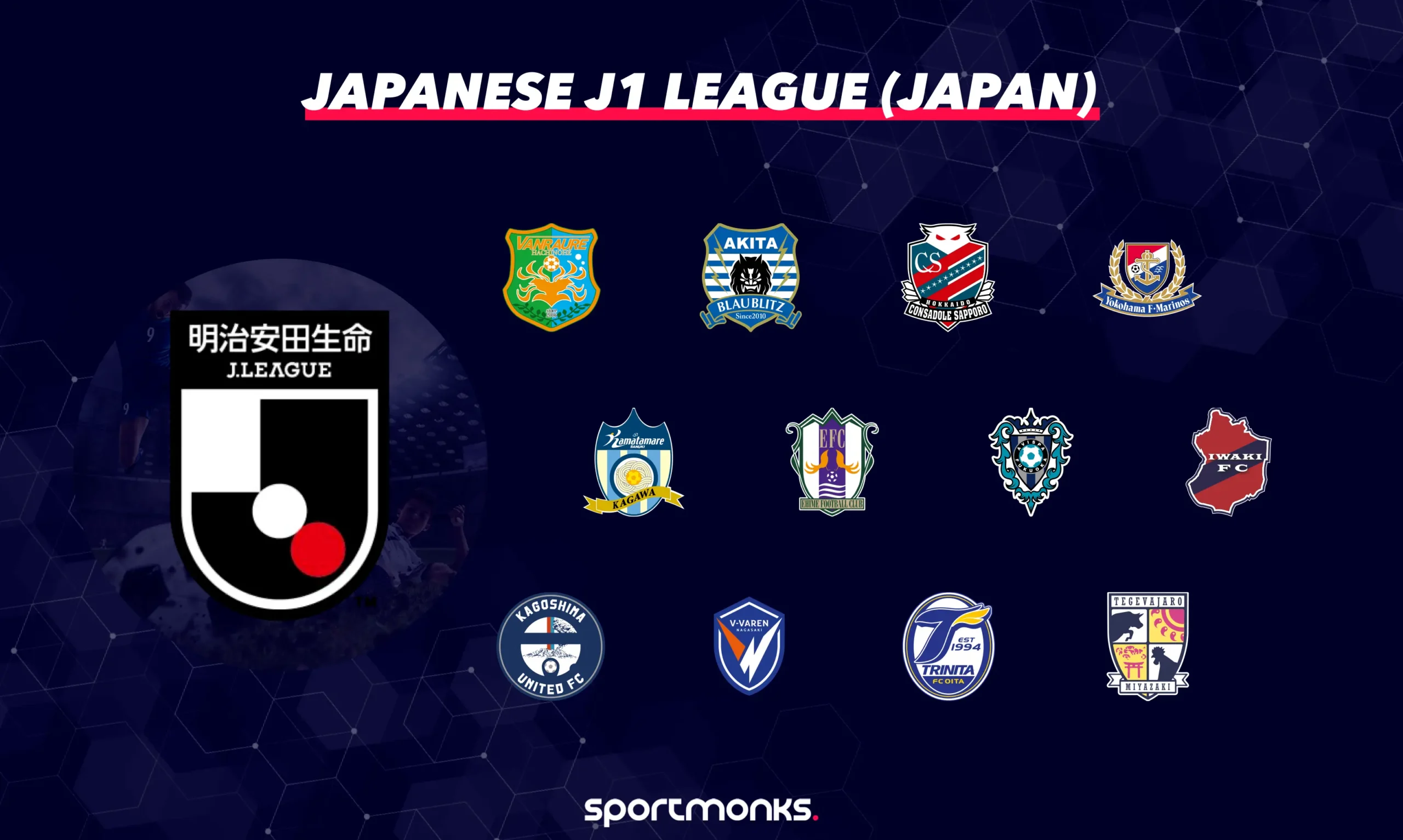
There are 20 clubs participating in the current 2025 season. They are spread out across Japan, which shows the league’s regional representation.
Stadiums & geographic spread
The stadiums have a wide range of capacities, from around 15,000 to over 70,000. Some stadiums are known by their sponsorship names, such as Ajinomoto Stadium and Saitama Stadium 2002.
Attendance & fan metrics
– In the 2024 season, the total attendance for all J.League matches was 12,540,265, which was a new record.
– For J1 matches alone, the attendance was 7,734,871.
– In the 2025 season, the average attendance per match so far is about 20,851 spectators. The highest attendance for an individual match was around 59,574, and the lowest was 6,157.
Club performance / historical records
– Most successful club: Kashima Antlers has won the most league titles with 8.
– Never relegated: Kashima Antlers and Yokohama F. Marinos are the only two clubs that have never been relegated from J1.
Recent season highlights / key stats
As of mid-September 2025, the season has seen some interesting stats. Fagiano Okayama is in its first season in J1. The season has had a certain number of matches played, with a total number of goals scored, and there have been notable streaks (win, unbeaten, loss, etc.) by various clubs.
Sportmonks & the J1 League
What is Sportmonks?
Sportmonks is a great provider of football data. Its API offers live, historical, and statistical data for many domestic leagues around the world, including the J1 League. The API provides data such as live scores, player stats, league tables, and schedules for the J1 League.
Relevant endpoints / features
– Leagues & seasons endpoints: You can get all the J1 League information you need using these endpoints. This includes details about the league structure, the teams playing in it, and the schedule.
– Fixtures: This gives you match schedules, results (home/away), and event details.
– Standings / live standings: You can get the current season’s league table and live rankings as matches happen.
– Player statistics, team statistics: You can get data on goals, appearances, and other stats for players and teams.
API versions & updates
There is a newer API version (3.0) with extra endpoints for referees, predictions, and schedule improvements. This new version also has better typing, filtering, and new features, giving you more detailed data.
Bring the J1 League closer with Sportmonks
The J1 League is one of Asia’s most competitive and innovative football competitions, and with Sportmonks you can follow it in detail from kick-off to the final whistle. Our Football API delivers live scores, fixtures, player and team statistics, league tables, historical data, and predictive insights, giving you everything you need to track the action and provide deeper analysis. Whether your focus is on building a fan platform, powering scouting and performance tools, or enhancing betting content, Sportmonks provides the speed, accuracy, and reliability you can trust. Start exploring the Sportmonks Football API today and bring Japan’s top flight to life for your audience.
Faqs about the J1 League