
Contents
World Cup 2026 coverage
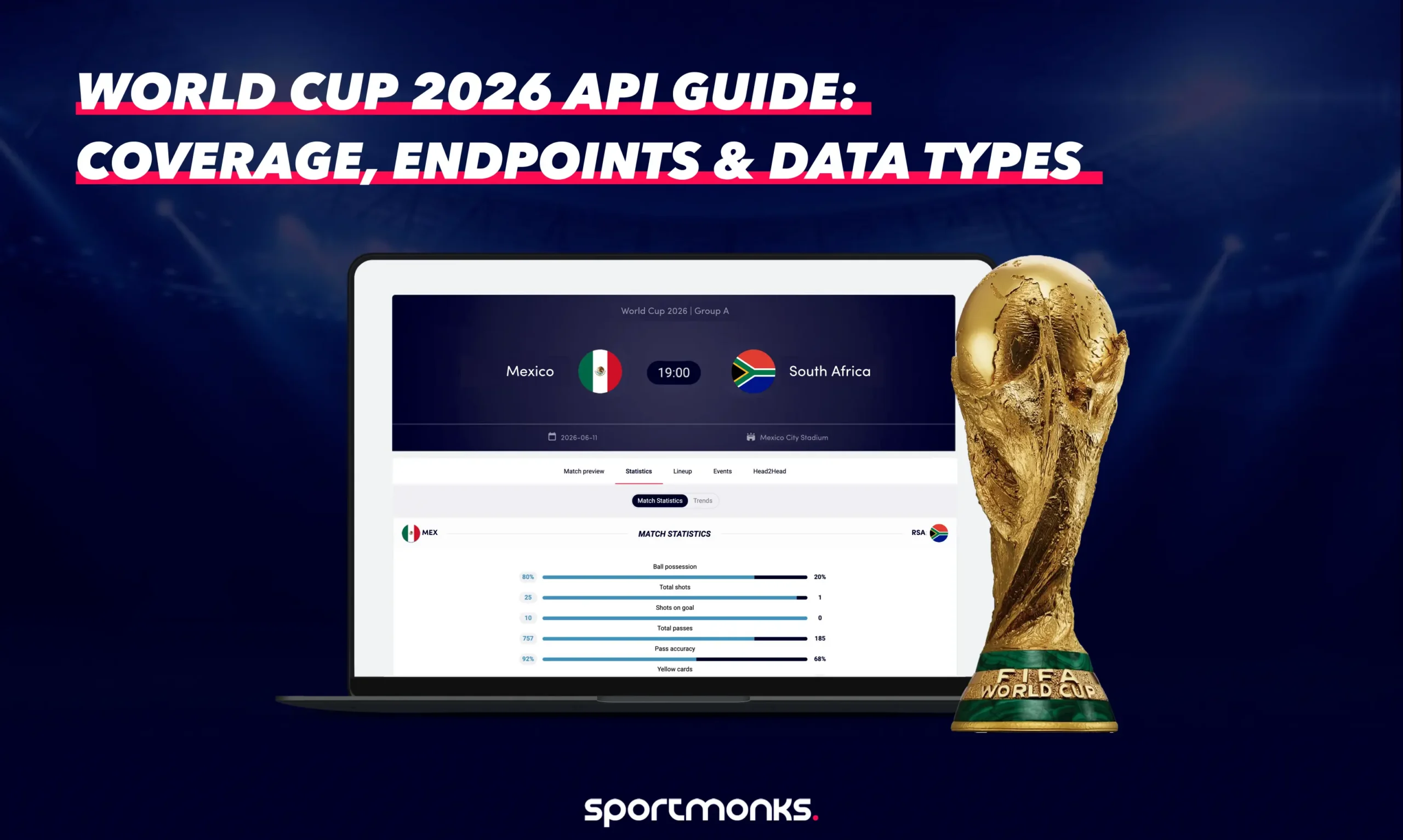
The Sportmonks API provides comprehensive coverage of the FIFA World Cup 2026, including both the qualification phase and the main tournament. The tournament is identified by Season ID 26618 in our API.
Tournament structure
The World Cup 2026 consists of multiple stages:
– Group Stage (Stage ID: 77478590) – 3 rounds of group phase matches
– Knockout Stages: Round of 32 (77479086), Round of 16 (77479087), Quarter-finals (77479088), Semi-finals (77479089)
– Finals: 3rd Place Final (77479091) and Final (77479090)
Participating teams
The API provides data for all 48 participating teams, including football powerhouses like Brazil (18704), Argentina (18644), France (18647), Germany (18660), England (18645), and Spain (18710), as well as teams from all confederations across six continents. Each team has a unique team ID that can be used to retrieve specific team data.
API Fundamentals
Base URL & Authentication
The base URL for all football endpoints is:
https://api.sportmonks.com/v3/football
Sportmonks API supports two authentication methods:
– Query Parameter: ?api_token=YOUR_TOKEN
– Authorization Header: Authorization: YOUR_TOKEN
Both methods count toward the same rate limit. API tokens never expire and can be managed through MySportmonks.
Rate limits
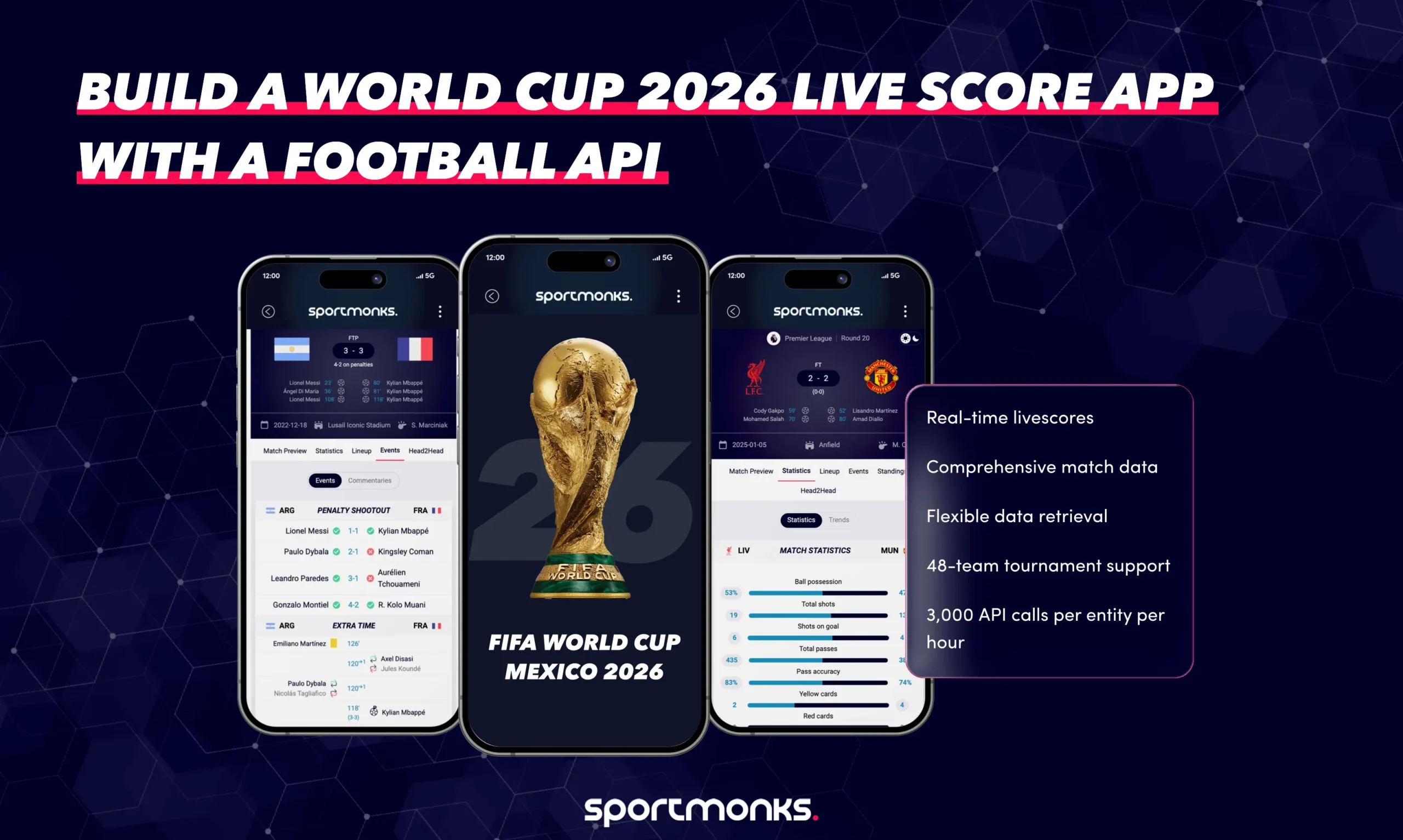
Rate limits are applied per entity (not per endpoint) with a standard limit of 3,000 requests per entity per hour for enterprise plans. Each API response includes a rate_limit object in the meta section that shows the remaining requests and the reset time. When you exceed the limit, the API returns a 429 status code.
Core endpoints for World Cup 2026
Sportmonks doesn’t provide tournament-specific endpoints. Instead, you use standard football endpoints with filters to access World Cup data. Here are the essential endpoints for building World Cup applications:
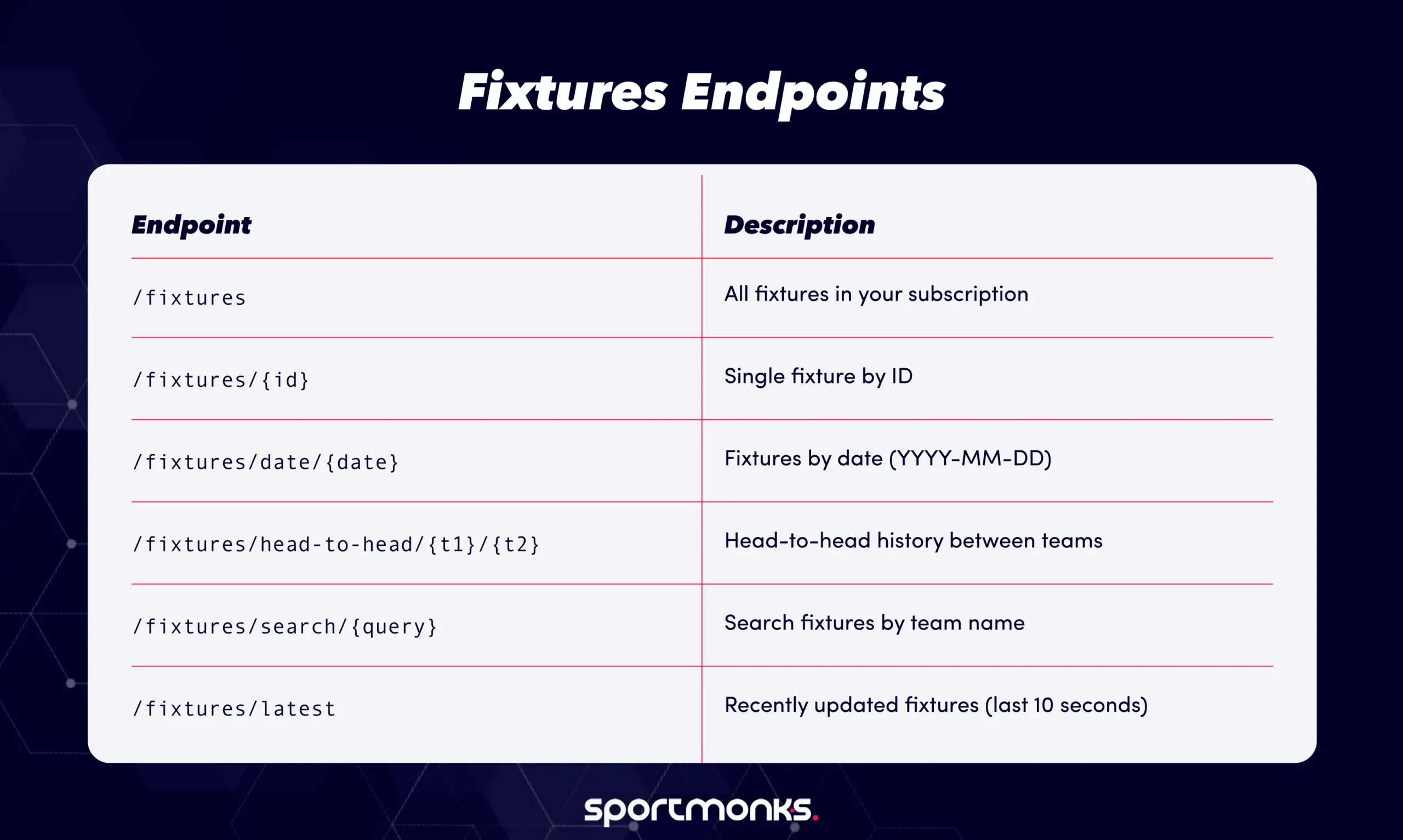
Fixtures & Livescores
Leagues & Seasons
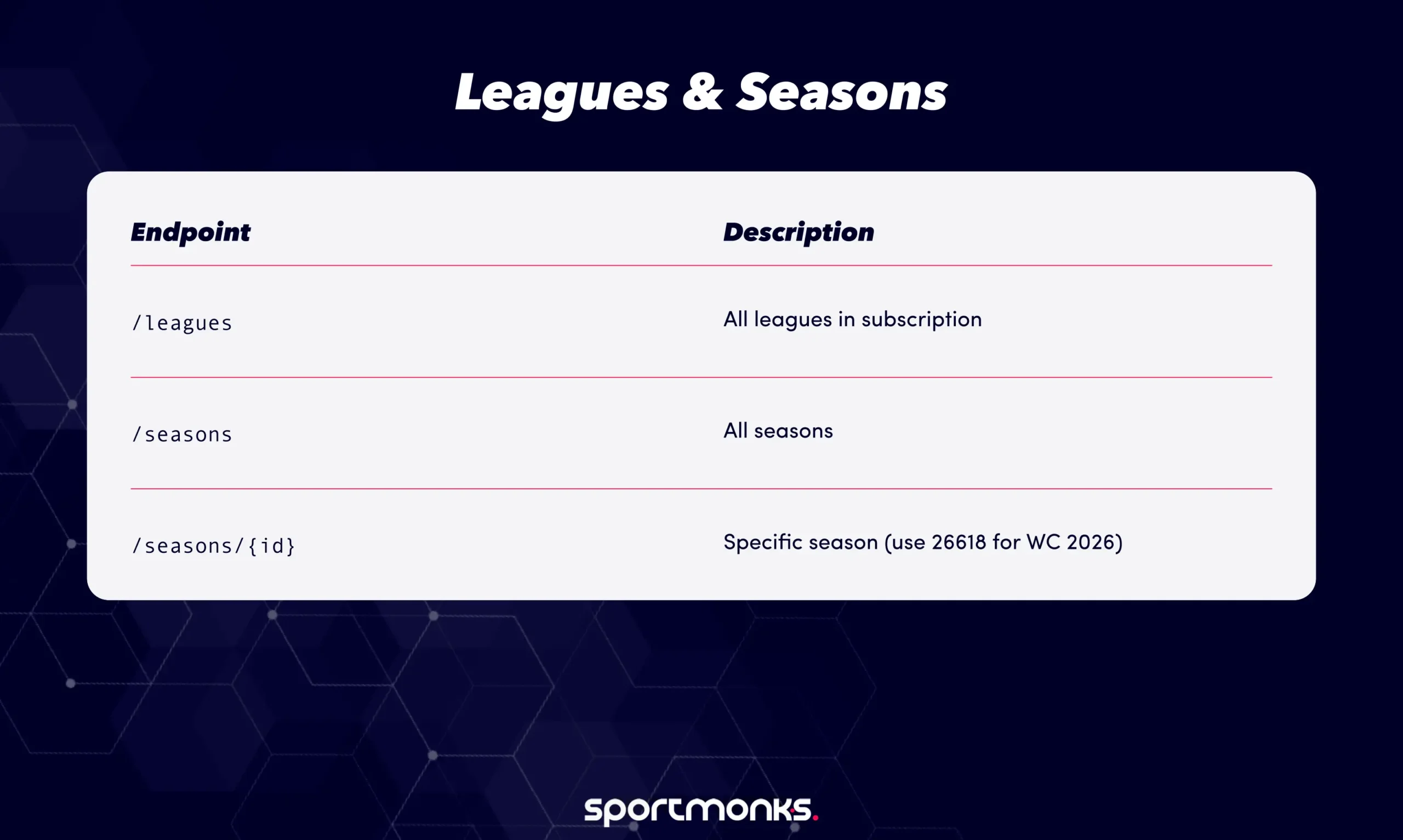
Teams & Players
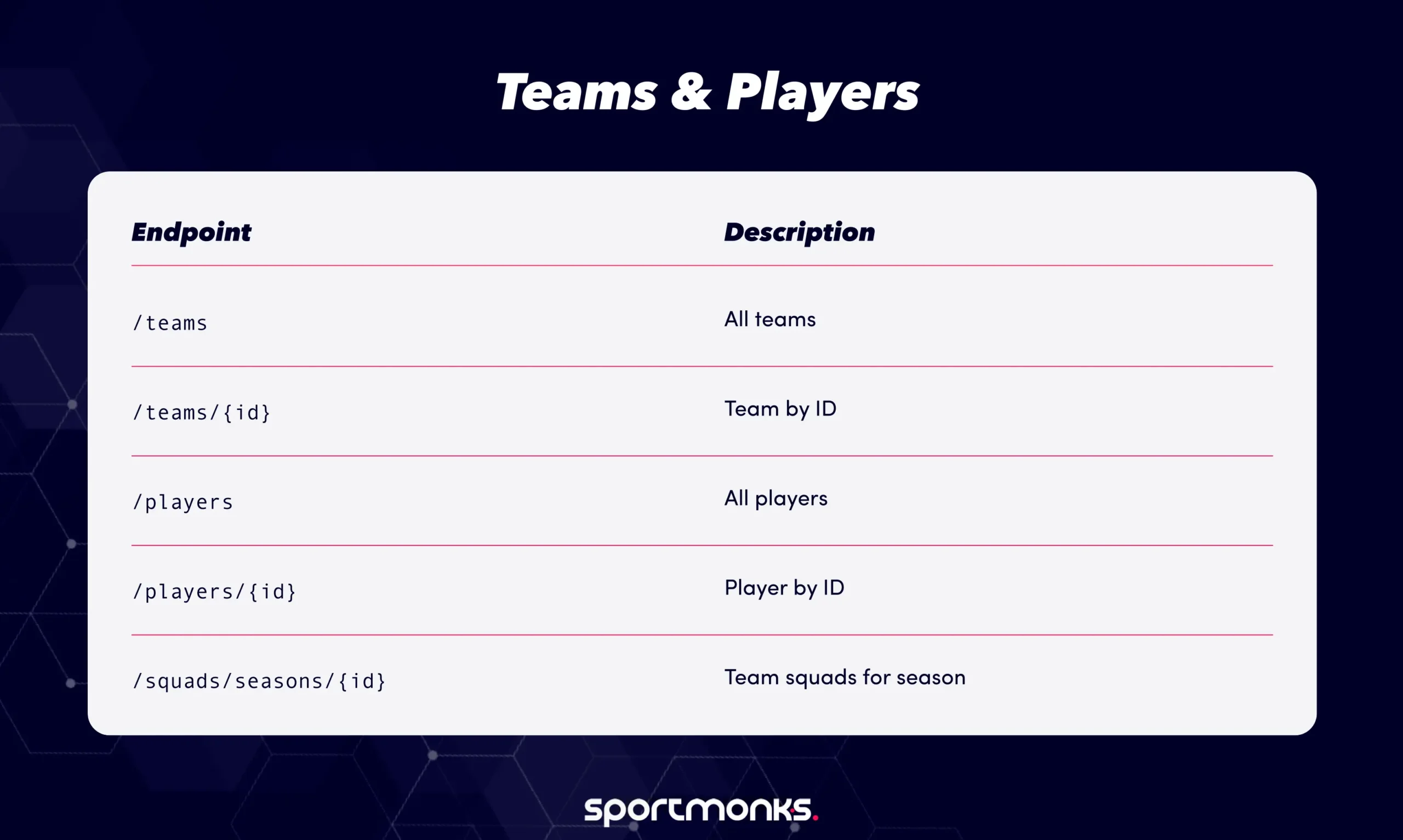
Standings
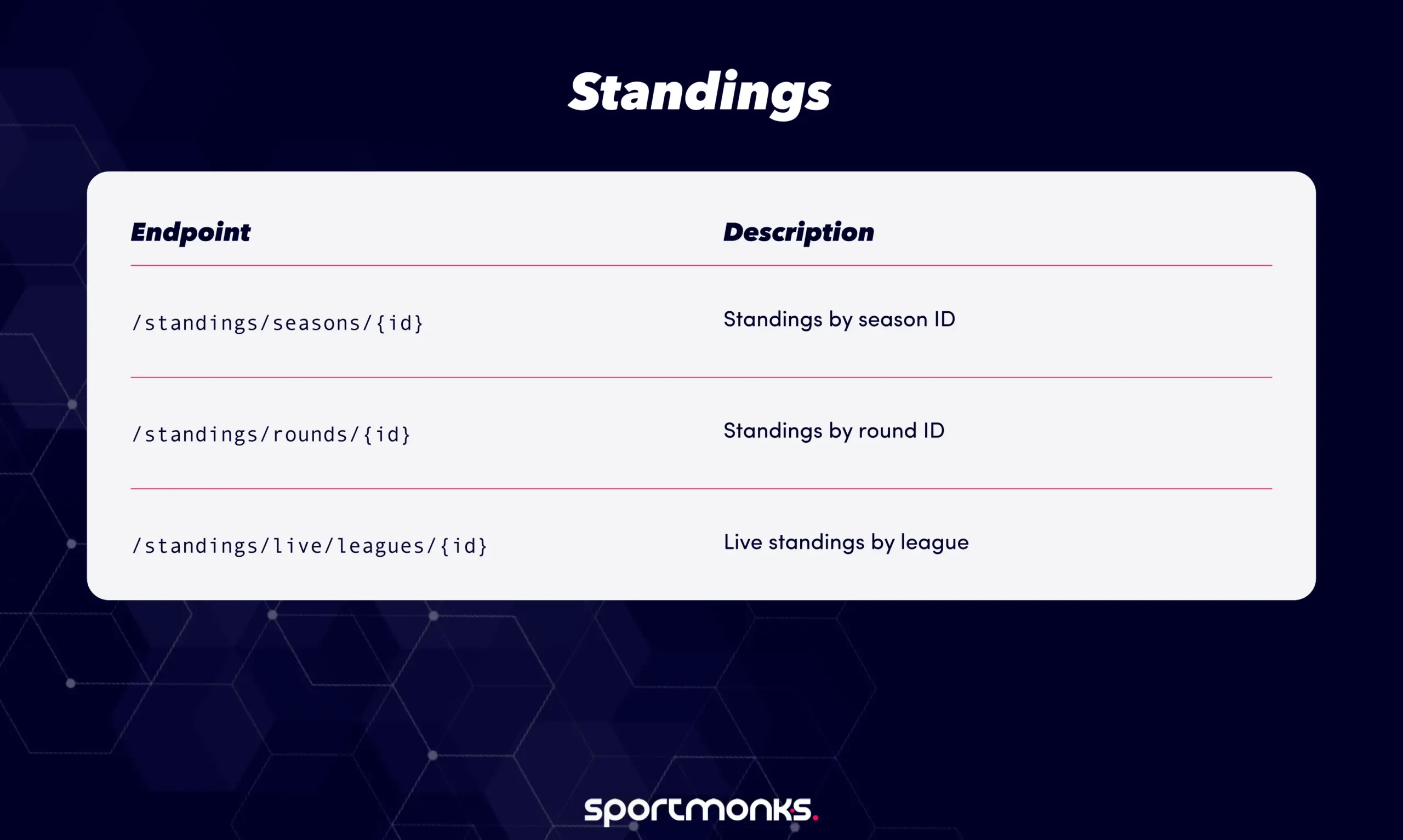
Statistics
Statistics are accessed through includes on fixtures, teams, and players endpoints rather than dedicated endpoints.
Venues
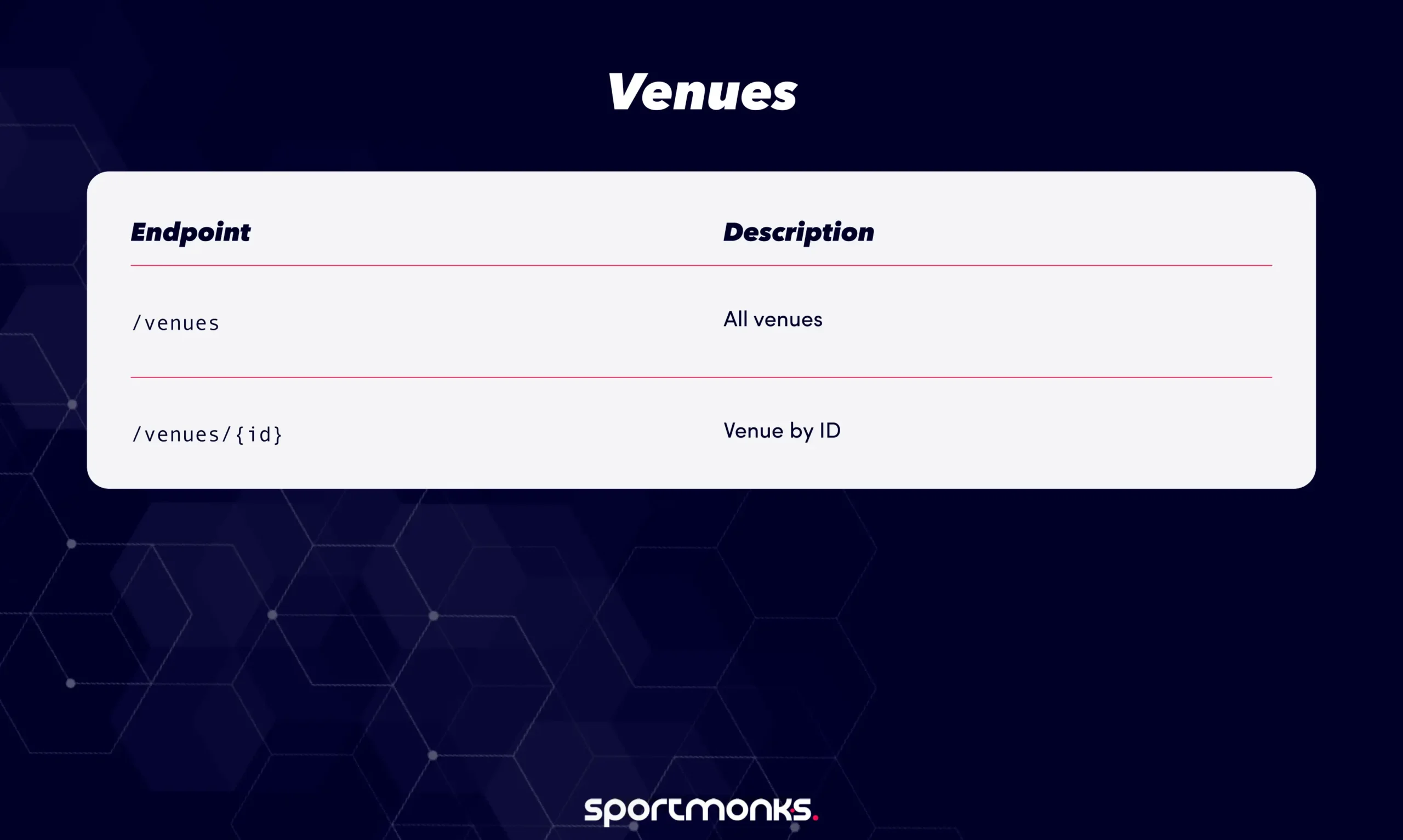
Data types & includes
The Sportmonks API uses an includes system to enrich responses with related data. By default, endpoints return basic information, but you can add related entities using the include parameter.
Essential includes for fixtures
– participants – Team information (replaces old localTeam/visitorTeam)
– scores – Score information by period (HT, FT, current)
– events – Match events (goals, cards, substitutions)
– lineups – Starting lineups and player statistics
– statistics – Team-level match statistics (shots, possession, etc.)
– state – Match state (NS, FT, LIVE, etc.)
– venue – Stadium information
– periods – Period timing information
– formations – Team formations
– referees – Match officials
– metadata – Additional match info (pitch conditions, colors, hashtags)
Nested includes
You can chain includes using semicolons (;) and access nested data with dots (.):
?include=participants;events.player;statistics.type
Advanced data: Expected goals (xG)
For subscribers with xG packages, the API provides Expected Goals data through dedicated endpoints:
– /expected/fixtures – xG values by team
– /expected/lineups – xG values by player
xG values are updated continuously during matches, with updates every couple of minutes (up to 5-minute intervals).
Filtering & selection
Filtering World Cup fixtures
To retrieve only World Cup 2026 fixtures, filter by season ID:
GET /fixtures?filters=fixtureSeasons:26618
Field selection
Reduce response size by selecting only required fields using the select parameter:
?select=id,name,starting_at,result_info
Common filter patterns
– By stage: filters=fixtureStages:77478590 (Group Stage)
– By state: filters=fixtureStates:1 (Not Started)
– By participant: filters=participantSearch:Brazil
– Multiple filters: filters=fixtureSeasons:26618,fixtureStates:5
Pagination
API v3 uses cursor-based pagination. Each response includes a has_more boolean in the meta section to indicate if more results exist:
– per_page: Items per page (default 25, max 50)
– page: Page number
Example:
?per_page=50&page=2
Response format
All responses follow a consistent JSON structure with data and meta sections:
{
 "data": { /* Entity data */ },
 "meta": {
   "rate_limit": {
     "remaining": 2999,
     "resets_in_seconds": 3600
   },
   "pagination": {
     "has_more": true
   }
 }
}
Building a World Cup 2026 application
Typical implementation flow
- Initialise: Fetch season data (ID: 26618), including stages, groups, and teams
- Display fixtures: Query fixtures by date or stage with includes for participants, scores, and state
- Live updates: Poll /livescores/inplay or /fixtures/latest for real-time data
- Match details: Fetch individual fixtures with comprehensive includes (events, lineups, statistics)
- Standings: Retrieve group standings using /standings/seasons/26618
Best practices
– Cache static data: Team names, venues, and league info rarely change
– Smart polling: Use /fixtures/latest for updates rather than polling all fixtures
– Selective includes: Only request includes you actually need
– Monitor rate limits: Check the rate_limit object in responses
– Error handling: Implement exponential backoff for 429 responses
– Use filters: Reduce data transfer by filtering at the API level
Complete example request
Here’s a comprehensive request for World Cup group stage fixtures:
GET https://api.sportmonks.com/v3/football/fixtures
 ?api_token=YOUR_TOKEN
 &filters=fixtureSeasons:26618
 &filters=fixtureStages:77478590
 &include=participants;scores;state;venue
 &select=id,name,starting_at,result_info
 &per_page=50
This returns all Group Stage fixtures with team info, scores, match states, and venues, limiting the response to essential fields.
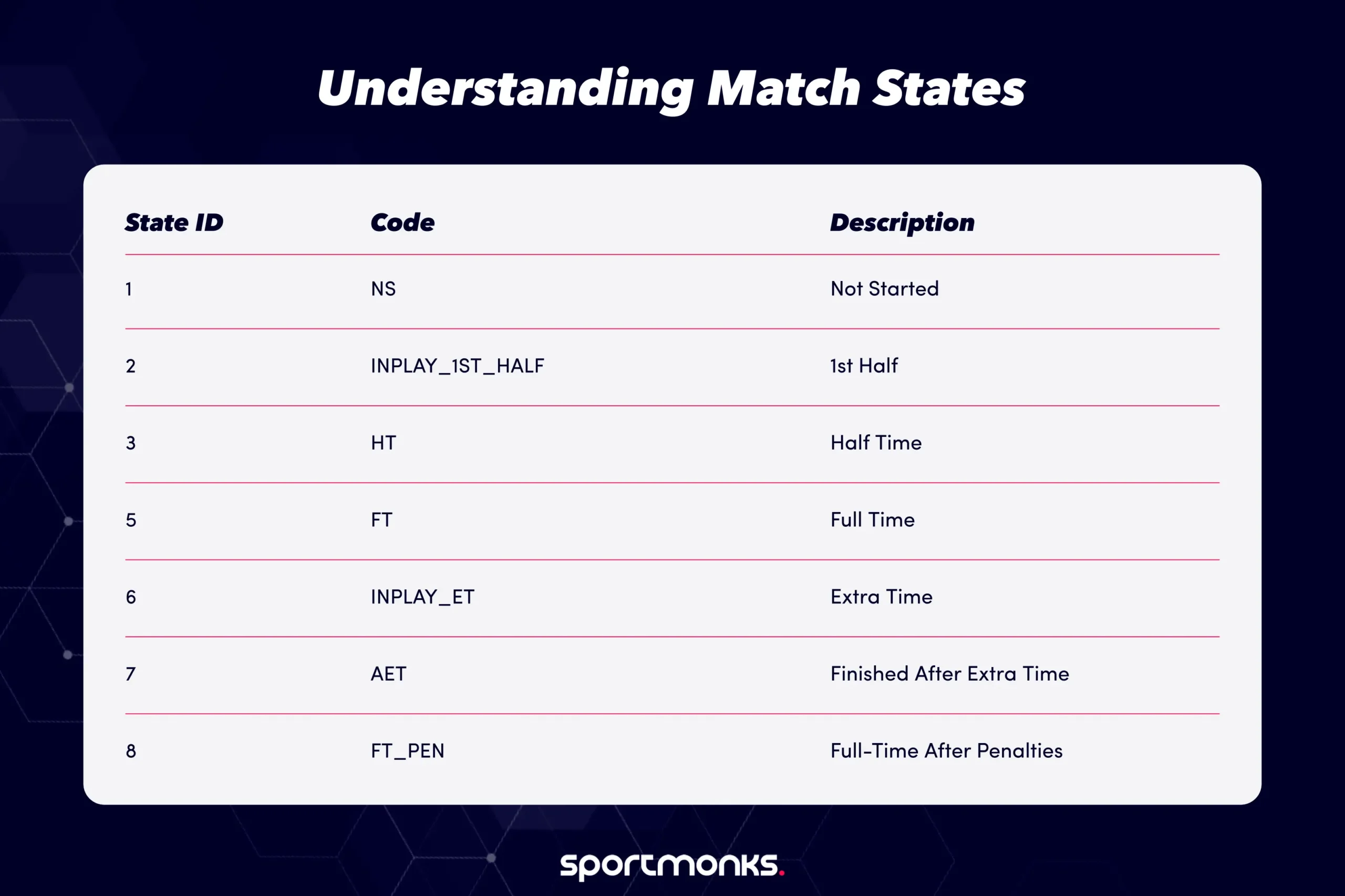
Understanding match states
The state_id field indicates a fixture’s current status. Common states include:
Conclusion
The Sportmonks Football API v3 provides comprehensive, real-time access to World Cup 2026 data through a flexible, well-documented REST API. With proper use of filters, includes, and pagination, developers can build robust football applications that deliver exceptional user experiences during the tournament.
Key takeaways for building World Cup 2026 applications:
– Use Season ID 26618 to filter World Cup data
– Leverage the includes system to get comprehensive data in a single request
– Monitor rate limits and implement smart caching strategies
– Use /fixtures/latest and /livescores/inplay for efficient real-time updates
– Filter at the API level to reduce bandwidth and improve performance
For complete API documentation, code examples, and support, visit docs.sportmonks.com/v3 or contact support at [email protected].