Contents
What is Asian handicap betting?
Asian handicap betting changes the score used for settlement by assigning one team a positive or negative goal handicap.
The stronger side usually receives a negative line. If a favourite is priced at -1, one goal is effectively deducted from its score when the bet is settled.
The weaker side receives the corresponding positive handicap. A team backed at +1 has one goal added for settlement purposes.
This creates a two-sided market focused on the winning margin rather than simply asking which team will win the match.
The handicap itself does not change the actual score, league table or match result. It exists only for settling the bet.
How Asian handicap betting lines work
The meaning of the market depends on whether the handicap is a whole number, half number or quarter number.
A whole-number handicap can produce a push. With a favourite at -1, a two-goal victory wins the bet, while a one-goal victory makes the adjusted score level and the stake is returned
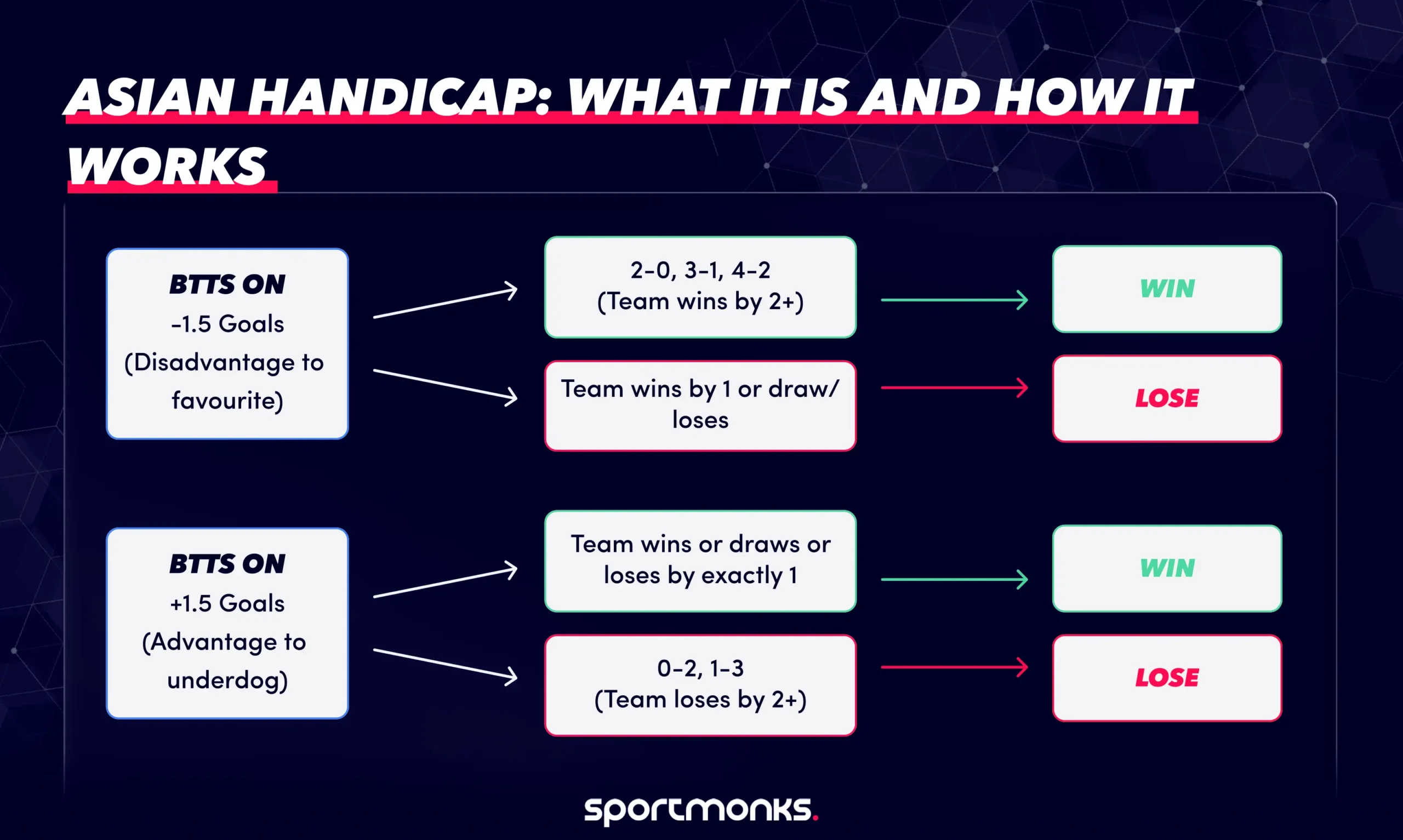
A half-number line removes that possibility. A favourite at -1.5 either covers the line by winning by two or more goals, or fails to cover it.
Quarter lines sit between those two prices by dividing the stake equally between adjacent handicap lines.
A bet at -1.25, for example, is half a stake at -1 and half at -1.5.
That split is the key to understanding quarter-goal settlement.
What does a -1 Asian handicap mean?
Suppose you back the home team at -1.
If the home team wins 3-1, subtracting one goal leaves an adjusted result of 2-1. The bet wins.
If the home team wins 2-1, subtracting the handicap produces an adjusted 1-1 score. The bet pushes and the stake is returned.
If the match ends 1-1, or the home team loses, the handicap bet loses.
The real match result still matters because it determines the starting score. The handicap simply changes the margin required for the selected side to win the bet.
What does -1.5 mean?
A -1.5 line gives the favourite a one-and-a-half-goal disadvantage.
Because a football match cannot finish with a half goal, this line cannot push.
If the favourite wins 2-0, subtract the handicap:
2 – 1.5 = 0.5
The favourite still has a positive adjusted margin, so the bet wins.
If the favourite wins only 1-0:
1 – 1.5 = -0.5
The adjusted margin is negative, so the handicap bet loses even though the team won the actual fixture.
This distinction is why backing a team to win and backing that team at -1.5 are two different bets.
How quarter handicaps work
Quarter handicaps split the stake equally between two neighbouring lines.
A -1.25 bet is half the stake at -1 and half at -1.5.
Suppose the favourite wins by exactly one goal.
The -1 half pushes, so that half of the stake is returned.
The -1.5 half loses.
The overall result is therefore a half loss rather than a full loss.
If the favourite wins by two or more goals, both halves win.
The same principle works in the other direction. A +0.25 line is split between 0 and +0.5, while +0.75 is split between +0.5 and +1.
For a betting product, it is safer to store -1.25 as a numeric handicap and apply settlement logic than to treat a display label such as -1 / -1.5 as a completely different market.
Why Asian handicap markets use these line types
The purpose of the handicap is to move the betting question away from a simple match winner and towards the margin between the teams.
In a heavily one-sided fixture, the favourite may have a very short price in a traditional result market. Moving that side to -1, -1.5 or another handicap creates a different risk-and-reward balance.
Half lines make settlement binary.
Whole lines preserve the possibility of a refund.
Quarter lines create a price point between those two values by splitting the stake.
The result is a market that can adjust gradually as the perceived difference between the teams changes.
Asian handicap vs European handicap
Asian handicap and European handicap are related but should not be treated as identical.
Asian handicap markets commonly use whole, half and quarter lines. Whole lines can push, while quarter lines can create half wins or half losses.
European handicap markets normally remain three-way markets. After the handicap is applied, the adjusted result can still be home win, draw or away win.
That difference affects both the user interface and settlement logic.
A betting platform should therefore identify the market rather than assuming that every handicap value follows Asian settlement rules.
Asian handicap vs Double Chance
Double Chance protects a selection by combining two possible match outcomes, such as home win or draw.
Asian handicap changes the effective score instead.
For example, backing an underdog at +0.5 can behave similarly to a draw-or-underdog Double Chance selection because the team wins the handicap bet if it draws or wins.
The market structures are still different. Asian handicap can move through values such as +0.25, +0.75 or +1.5, producing settlement possibilities that a simple Double Chance market does not offer.
Asian handicap vs Over/Under
Over/Under goals applies a line to the total number of goals scored in the match.
Asian handicap applies a line to the difference between the two teams.
A match can therefore contain both markets at the same time.
A bettor might take the favourite at -1.25 based on an expected winning margin while separately betting Over 2.5 because they expect at least three total goals.
For product builders, the distinction is important because the handicap value belongs to a participant-side market, while an Over/Under line describes a match total.
Asian Handicap in the Sportmonks Odds API
Sportmonks’ current API v3 Markets tutorial lists Asian Handicap with id: 6, legacy_id: 28 and developer name ASIAN_HANDICAP. The documentation explains that legacy_id represents the ID used in the older API.
This means older Sportmonks examples that identify Asian Handicap as market 28 should not automatically be copied into a new v3 integration.
The market catalogue should be the source of truth for the current identifier:
GET https://api.sportmonks.com/v3/odds/markets\
The current documentation also shows that market records expose fields including id, legacy_id, name and developer_name.
Older Odds API documentation still contains a separate market list in which Asian Handicap is shown as ID 28, alongside 3Way Result as 1 and Over/Under as 12. That documentation represents the older market-ID scheme and is why legacy references need to be distinguished from current v3 IDs.
Reading Asian handicap odds from a fixture
Pre-match odds responses include fields such as fixture_id, market_id, bookmaker_id, label, value, market_description, total and handicap.
For an Asian handicap market, the handicap field is particularly important because it describes the line associated with the price.
A product should not identify an Asian handicap selection from the label alone. Use the current market relationship and the handicap value together.
That allows one parser to handle different available lines for a fixture while preserving the distinction between the market itself, the bookmaker offering it, the handicap and the quoted price.
The Sportmonks Odds API documentation can also be used to retrieve the current market catalogue before mapping IDs in an application.
Reading handicap lines in a betting product
A betting or odds-comparison application normally needs to keep the handicap and price as separate values.
For example, -1.25 describes the line. Decimal odds such as 1.90 describe the price attached to one side of that line.
Combining those two values into one display string is useful for the frontend, but the database should preserve them separately.
The handicap should also be stored as a signed numeric value where possible.
That makes it easier to compare movement from -1 to -1.25, group equivalent offers from different bookmakers and calculate the correct settlement path.
Line movement can be more meaningful than a small change in price. Moving a favourite from -1 to -1.5, for example, changes the match margin required for a full win rather than merely changing the return on the same outcome.
Sportmonks’ Premium Odds material also describes access to odds history and changes, which can support products interested in how prices and lines move over time.
Common Asian handicap mistakes
One common mistake is assuming every Asian handicap removes the draw. Whole-number lines can still push when the adjusted scores are level.
Another is treating a push as a winning bet. A push returns the relevant stake and should normally be handled separately from wins and losses in performance reporting.
Quarter handicaps also need explicit split settlement. A -1.25 selection should not be settled as though it were simply -1.5.
Products should also avoid mixing old and new Sportmonks market IDs. In current v3 documentation, Asian Handicap is ID 6 and 28 is the legacy ID.
Finally, settlement scope matters. A product should follow the bookmaker or feed’s documented rules for whether the market covers regulation time only or another period rather than assuming every handicap market uses identical settlement conditions.
Building with Sportmonks odds data
A betting platform can combine Asian handicap odds with fixtures, teams and other football data through the Sportmonks ecosystem.
The odds response provides the market, bookmaker, line and price relationships needed to display available selections, while the wider Football API supplies the fixture and participant context.
For pricing or betting applications, the Sportmonks Predictions API can provide another analytical input alongside market odds.
The important implementation detail is to keep prediction output separate from bookmaker pricing. A model estimate and an Asian handicap line answer related questions, but they are not the same data source.
Related reading
Over/Under goals explains markets settled against a total-goals line rather than a team handicap.
Double Chance covers a result-based market that combines two match outcomes.
The Sportmonks Markets documentation explains the current v3 market catalogue and legacy-ID mapping.
Faqs
