Contents
What are final third entries in football?
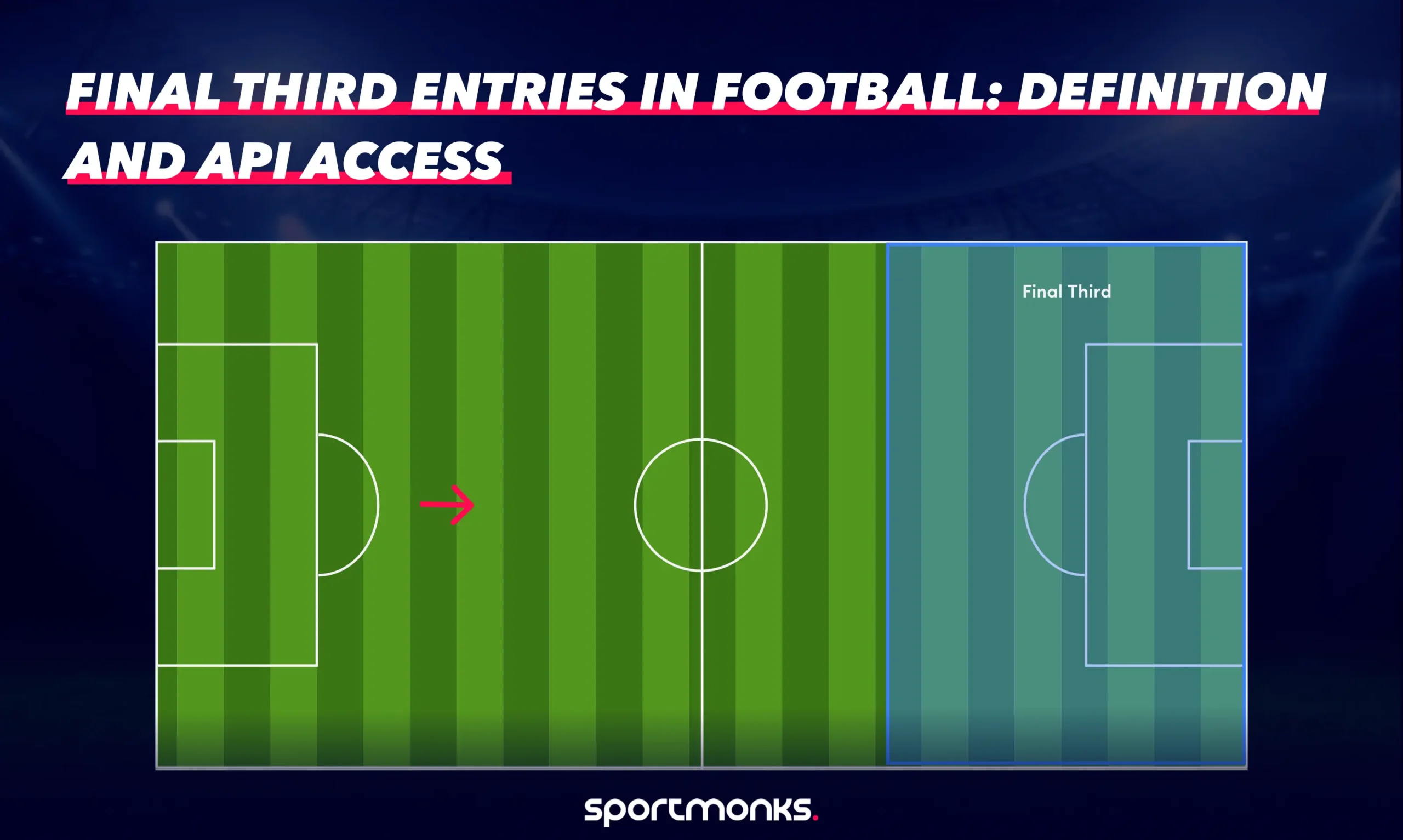
Final third entries in football count the number of occasions when a team successfully carries or passes the ball into the opponent’s final third: the area of the pitch from the opponent’s goal line to approximately 33% of the total pitch length. Each entry represents a moment when the attacking team has penetrated into the most dangerous offensive zone and is now positioned to create goalscoring opportunities. Final third entries are a territorial attacking metric: a high count reflects consistent ability to push play into advanced positions where the probability of creating shots and goals is highest. The metric is complementary to defensive third entries, which tracks the same event from the conceding team’s perspective, and it is widely used in attacking analysis, scouting, and applications where territorial control is a key output dimension.
How final third entries are defined and recorded
A final third entry is recorded when a player carries or passes the ball across the boundary between the middle third and the opponent’s final third while in possession. The key requirement is that the attacking team successfully establishes or receives the ball in possession inside the zone: a speculative long ball played into the final third that is won in the air by the defending team does not generate a final third entry.
The final third boundary is set at the area extending from the opponent’s goal line to approximately 35 metres from their goal on a standard pitch. The exact boundary may vary by provider, but the zone is consistently the 33% of the pitch closest to the opponent’s goal.
Entry types
Final third entries occur through several means: a progressive pass received by a player who has advanced into the zone, a carry where the ball-carrier dribbles across the boundary, or a combination play between two players that results in one of them receiving the ball inside the zone. They do not include long aerial balls that are cleared before possession is established, or passages of play where the ball enters the zone but neither team takes possession before it goes out of play.
What final third entries reveal
Attacking territorial control
Final third entries are a direct measure of attacking territorial control. A team that consistently enters the opponent’s final third at high volume is dominating the game positionally and creating the conditions for shot creation. A team with low final third entries is struggling to advance past the opposition’s midfield structure and is unlikely to create high-quality chances.
In most analytical models, final third entries are positively correlated with shots created and expected goals. Teams with high final third entry counts are, on average, generating more attacking threat per match.
Attacking system effectiveness
The number of final third entries reflects how effectively a team’s attacking system breaks through defensive blocks. A possession-based team might enter the final third through a high number of short, progressive passes. A direct team might enter primarily through vertical carries and through balls. Tracking the type of entry (pass-based vs. carry-based) reveals the mechanism by which the team creates its territorial advantage.
Match state and tactical context
Final third entry counts vary with match state. A team chasing the game will typically increase their final third entries as they push forward. A team protecting a lead will typically reduce entries as they invite pressure and defend deeper. Tracking final third entries per 15-minute period within a match reveals how the territorial battle shifts as the game progresses.
Comparison to shots and goals
The conversion chain from final third entry to shot to goal is a useful attacking efficiency model. A team recording 40 final third entries per match but only 8 shots and 0.8 goals is entering the zone regularly but failing to create quality inside it. A team with 25 entries generating 14 shots and 1.8 goals is converting entries to shots and goals at a high rate. These two teams are attacking differently, and the entry-to-shot and shot-to-goal ratios distinguish them.
Scouting and recruitment
Final third entries per 90 minutes is a useful metric for evaluating midfielders and forwards in terms of their ability to drive into advanced positions. Players with high final third carry rates are ball-progressors who physically move the team forward. Players who receive in the final third at high rates are positioning well to receive in dangerous areas. Both profiles contribute to final third entries in different ways.
Final third entries and defensive third entries
Final third entries and defensive third entries measure the same type of event from opposite perspectives:
Final third entries (this article) counts how often the attacking team enters the opponent’s final third. It is an attacking metric.
Defensive third entries counts how often the opposing team enters a team’s own defensive third. It is a defensive pressure metric.
For a complete territorial picture, analysts track both: how often the team enters the opponent’s final third (attacking dominance) and how often the opponent enters the team’s defensive third (defensive exposure). The gap between these two figures is a proxy for territorial balance across the match.
How to access final third entries via API
Ball position data is available through the ballCoordinates include, for competitions with optical tracking infrastructure.
GET /v3/football/fixtures/{fixture_id}?include=ballCoordinates
Returns x/y ball coordinates over time. Coverage concentrates in leagues with optical tracking infrastructure, typically top European competitions.
FAQs
