Contents
Origins and evolution
The modern 3-4-3 is thought to have come from Italy’s very defensive 3-5-2 system. Coaches wanted a more attacking balance, so they added a third forward. This changed the formation into a forward-leaning shape with three defenders and a front three.
The formation became more widely known when Johan Cruyff’s “Dream Team” at Barcelona in the late 1980s and early 1990s used it. His team often changed from a 4-3-3 to a 3-4-3 when they had the ball, using players’ fluid positions and a relentless back three. This showed how adaptable the system could be.
Since then, the 3-4-3 has been revived many times. Modern coaches like Antonio Conte have used its flexibility to great success at both club and international level. Other innovators like Gian Piero Gasperini and Walter Mazzarri have also pushed its boundaries with high-tempo, attacking football.
Basic structure & player roles
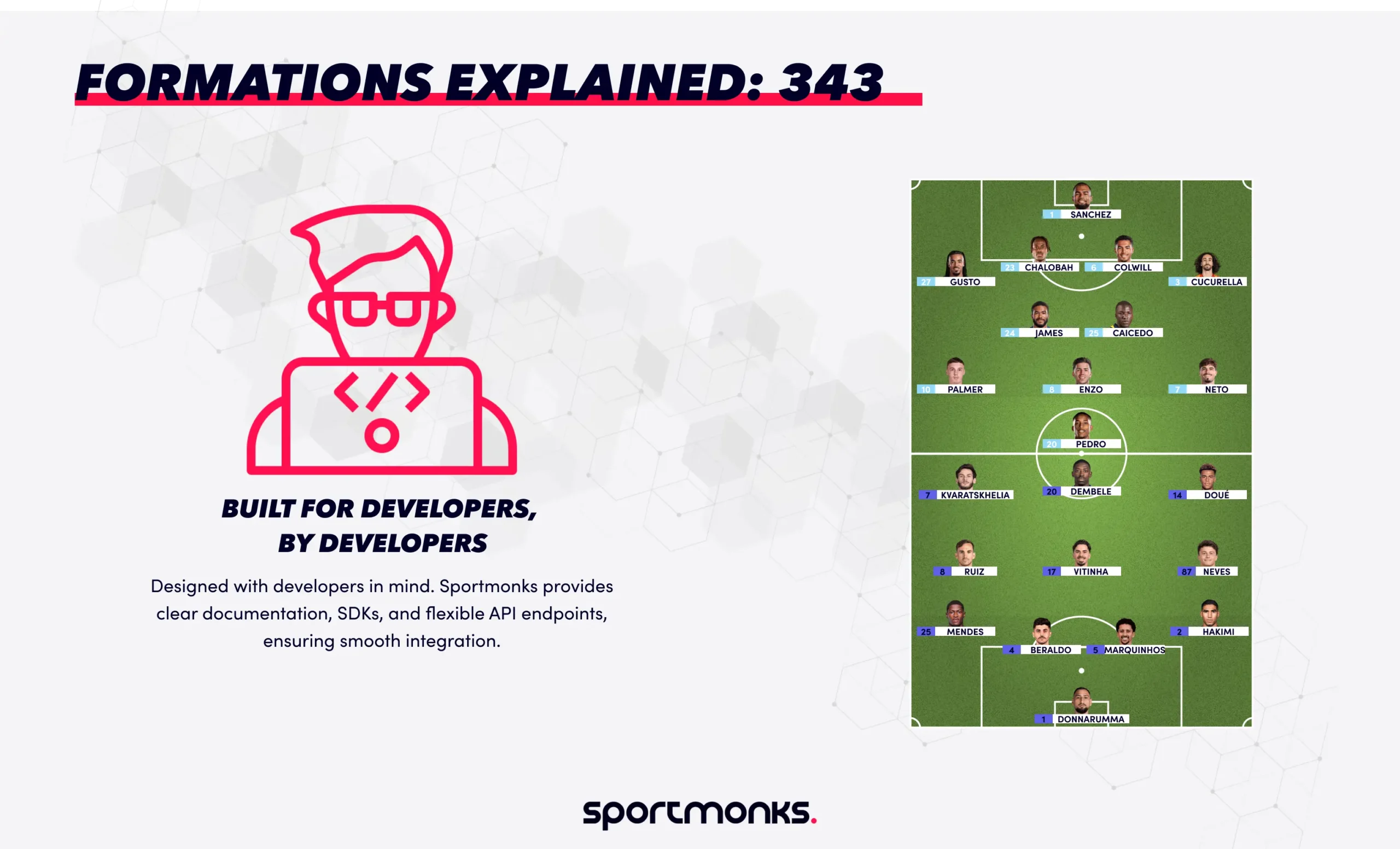
The 3-4-3 formation is made up of three central defenders, a midfield four (usually two central midfielders and two wing-backs), and a front three. Each part of the team has its own distinct job.
Three central defenders
These players form the core of the defence. Their job is to keep the back line solid and allow the wing-backs to push forward without leaving the defence exposed.
Two central midfielders (double pivot)
These two players provide balance and a link between the defence and the attack. They help recycle the ball, protect the defenders, and start attacks.
Wing-backs
These players are key to providing width and energy. They act as both defenders and attackers. When the team is defending, they drop back to form a five-man defensive line, and when the team has the ball, they push forward to stretch the opposition’s defence and put in crosses.
Front three
The front three often consists of a central striker with two other forwards on either side. The wide attackers may press aggressively or move inside to put pressure on the central areas. The striker’s main job is usually to be the focal point for finishing attacks or to create space for others.
This formation allows for smooth transitions between defence and attack. When defending, it can become a compact 5-2-3, while in attack, it expands with the wing-backs pushing wide and the front three constantly swapping positions.
Popular variations
The 3-4-3 formation is very flexible, with several variations designed to focus on different strengths, such as controlling the centre of the pitch or creating attacking threats from the wings.
Flat 3-4-3 (standard wing-back setup)
This is the most common version of the formation. It uses three central defenders, two central midfielders (a double pivot), and two wing-backs who provide width for the front three. This setup provides an excellent balance between defence and attack, using the wing-backs’ dual roles to maintain width.
3-4-3 diamond (midfield overload)
This variation changes the usual two central midfielders for a diamond shape, typically with one defensive midfielder and one central attacking midfielder. The structure gives the team more control and penetration through the centre, helping with both creative build-up and defensive stability.
Flexible front three configurations
The front three can be set up in a few different ways:
– Narrow front three: A central striker is flanked by two mobile players who act as “number 10s.” This setup is great for creating overloads in the middle of the pitch and quickly linking the midfield with the attack.
– Wide or flat front three: The wide forwards are positioned high up the pitch on the wings. This creates natural width and stretches the opposition’s defensive line.
– False nine or inside forwards: The central forward drops deep into midfield, acting as a “false nine.” This pulls defenders out of position and creates space for the other two forwards or midfielders to run into and take advantage of.
Tactical strengths & weaknesses
Strengths
– Width and attacking overloads via wing-backs: The wing-backs give a team two extra players in advanced positions. This allows them to make overlapping runs that stretch the opposition’s defence and create space in the middle. When they drop back, the system becomes a solid and compact five-man defensive line.
– Strong defensive foundation with flexible transitions: The formation naturally changes into a defensive shape of 5-5-0 or 5-3-2 when the team doesn’t have the ball. This gives them a strong defensive base. This fluid change allows teams to be solid when defending, but also expansive when they are attacking.
– Numerical advantage and control in midfield: The use of two central midfielders (a double pivot) or a diamond midfield helps the team control the tempo of the game and keep possession effectively. A diamond is especially useful for outnumbering the opposition in the centre of the pitch.
– Built for offensive versatility: The three forwards can be set up in many ways, such as narrow, wide, or with a “false nine” which makes them unpredictable for defenders.
Weaknesses
– Demanding wing-back role: The wing-backs must be both physically strong and tactically disciplined. They have to cover the entire length of the pitch in both attack and defence.
– Vulnerable central and wide space: The central part of the pitch can become weak if the opposition overloads it. Meanwhile, the three-man defensive line can be exposed by fast, direct attacks down the wings.
– High tactical and physical demands: The formation requires well-drilled, intelligent players who can adapt to changing roles smoothly, especially the midfielders and defenders. Any lack of cohesion, particularly from the wing-backs or in the midfield, can cause the shape to fall apart.
Counter-strategies
Opponents can use several tactics to disrupt the structure and strengths of the 3-4-3 formation.
Use a 4-2-3-1 formation
One of the most effective ways to counter the 3-4-3 is with a 4-2-3-1 system. This formation provides a strong defence and midfield control, which makes it difficult for the 3-4-3’s front three to dominate in attack.
Exploit space behind the wing-backs
When wing-backs push forward to provide width, they often leave exploitable space behind them. Opponents can take advantage of this by launching quick counter-attacks or by switching the play quickly to target these empty channels.
Overload the midfield
If a 3-4-3 team is weak in the centre, an opponent can flood the midfield with extra players. This will disrupt their possession, stop them from controlling the tempo, and stifle the flow of their play.
Tight marking of the front three
The formation’s attacking strength relies heavily on its front three. By marking these players closely and cutting off their supply of the ball, opponents can neutralise the 3-4-3’s main attacking threats. Attack through the wings and maintain compact defence.
While wing-backs create width, the areas just beyond them can be targeted with overlapping full-backs, long-range crosses, or diagonal runs. At the same time, maintaining a compact defence, especially in the central third, limits the key passing lanes and makes it harder for the attackers to find space.
Case studies: Teams & managers
Antonio Conte (Chelsea)
Antonio Conte successfully brought back the 3-4-3 formation at Chelsea during the 2016–17 Premier League season. He changed the team from a 4-1-4-1 into a dynamic 3-4-2-1, which could also become a 3-4-3 or even a 5-4-1 when the ball was won or lost.
His system used a three-man defence (David Luiz, César Azpilicueta, and Gary Cahill), a combative midfield pair (N’Golo Kanté and Nemanja Matić), and fluid wing-backs (Victor Moses and Marcos Alonso). The wing-backs supported two ‘inside forwards’ (Eden Hazard and Pedro).
This approach led to a remarkable run of 13 straight league victories and ultimately secured the Premier League title for Chelsea.
Johan Cruyff (Barcelona)
As part of Barcelona’s “Dream Team” era, Cruyff often used a fluid 3-4-3. His coaching philosophy was all about movement, technical skill, and players being able to swap positions. He put Pep Guardiola in a deep-lying playmaker role and used a system where the lines between midfield and defence were often blurred. This laid the foundation for the club’s identity and inspired future generations of possession-based football.
Gian Piero Gasperini (Atalanta)
Gasperini’s Atalanta is famous for its exciting, high-risk, possession-based style of play built around the 3-4-3. His adaptable formation frequently changes into variants like a 3-4-1-2 or 3-4-2-1, depending on the situation in the game. His system uses energetic wing-backs to provide width, while the team stays compact with little distance between the defence and attack. This is a key part of his aggressive, attacking philosophy.
Rúben Amorim (Sporting Lisbon & Manchester United)
Rúben Amorim is a modern supporter of the 3-4-3, which he has used with success at Sporting Lisbon and is now implementing at Manchester United. His system typically builds in a 3-2-5 shape when the team has the ball and changes to a 5-2-3 when defending. Attacking wing-backs are central to both parts of the game. Amorim’s strong belief in his 3-4-3 philosophy “there’s no plan B” highlights his confidence in the formation’s effectiveness.
Luis Enrique (Barcelona)
While Luis Enrique is more known for using a 4-3-3, he occasionally switched to a 3-4-3, particularly in important Champions League matches. In this system, Lionel Messi and Neymar would move inside, while overlapping full-backs provided width. At the same time, Iniesta or Ivan Rakitic would push into attacking roles. This formation was decisive during their famous 6-1 comeback victory against PSG.
How Sportmonks helps with tactical analysis
– Comprehensive data: Our football API provides detailed line-up and formation data through specific endpoints, such as formations, lineups, and lineups.detailedposition. This allows for precise visualisation and analysis of how teams are set up.
– Predictive line-ups: Sportmonks also supports expected line-ups, which gives you early insight into who is likely to start a match before the official team news is confirmed. This is great for pre-match previews or analysis content.
– Detailed schema: The data includes granular position categories (e.g., centre-back, left-wing, defensive midfield), ensuring you can accurately map players onto any formation, including the 3-4-3.
– Developer-friendly: Our documentation and guides, including instructions on how to build a match page with line-ups and formations, are easy to follow and make it simple to integrate and display the data clearly within your articles or tools.
Power your tactics with Sportmonks
Analysing a 3-4-3 requires precise formation and line-up data. With Sportmonks’ Football API, you can track team setups, player positions, and tactical shifts in real time. Our Premium expected line-ups also give you early insights before official announcements, helping you prepare previews, analysis, or betting models with confidence.
Start with Sportmonks today and turn raw data into tactical insights.
Faqs about the 3-4-3 formation