
Contents
Power unit revolution: The 50/50 hybrid split
The end of MGU-H
The 2026 power units represent the biggest change since hybrid engines debuted in 2014. The complex and expensive MGU-H (Motor Generator Unit – Heat), which recovered energy from exhaust heat and the turbocharger, has been eliminated. This component, whilst highly efficient, lacked road-car relevance and added high cost and complexity, discouraging new manufacturers from entering Formula 1.
Tripling electric power
Compensating for the MGU-H’s removal, the MGU-K (Motor Generator Unit – Kinetic) undergoes a massive upgrade:
– Current (2025) MGU-K: 120kW (160 bhp)
– New (2026) MGU-K: 350kW (470 bhp)
This represents a near-threefold increase in electrical power output. The MGU-K can now deploy a maximum power of 350kW to the rear wheels, dramatically increasing the car’s electrical performance.
The true power split
While marketed as a “50/50 split” between internal combustion engine (ICE) and electrical power, the reality is more nuanced:
– Internal combustion engine: Approximately 400kW (540 bhp)
– Electrical (MGU-K): 350kW (470 bhp) maximum
– Total power: Still over 1,000 bhp combined
However, because electrical power cannot be deployed continuously throughout the entire lap (due to battery capacity limitations), the ICE still provides the majority of power. The “50/50” figure represents theoretical peak power capabilities rather than sustained lap-average power delivery.
Engine specifications remain
The core engine architecture continues:
– Displacement: 1.6-litre V6
– Configuration: Turbocharged
– Compression Ratio: 16:1 (geometric, at room temperature)
– Maximum Fuel Energy Flow: 3,000 MJ/hour (down from previous fuel mass flow limits)
Doubled energy recovery
Energy recovery capabilities increase dramatically. The 2026 power units can recover approximately 8.5 megajoules per lap under braking, coasting, and part-throttle conditions, roughly double the current systems’ recovery rates. This increased recovery is essential to support the deployment demands of the more powerful MGU-Ks.
100% sustainable fuel: Carbon-neutral racing
Advanced sustainable components
For the first time in Formula 1 history, every car runs on 100% Advanced Sustainable Fuel. These “drop-in” fuels are chemically identical to conventional racing fuel in terms of performance but are derived entirely from sustainable sources.
Approved fuel sources:
– Carbon capture: CO₂ extracted directly from the atmosphere
– Municipal waste: Non-recyclable waste materials repurposed
– Non-food biomass: Agricultural waste, sawmill residue, or purpose-grown crops that don’t compete with food production
– Synthetic E-fuels: Hydrogen (from water electrolysis) combined with captured carbon using renewable electricity
Second-generation biofuels only
Any biofuel components must be “second-generation” biofuels, meaning:
– No crops that could be used for human food
– No land conversion from food production
– No contribution to deforestation
– Derived from high-cellulosic agricultural waste or municipal waste streams
Independent verification
The FIA established the Sustainable Racing Fuel Assurance Scheme (SRFAS), partnering with Zemo Partnership to provide independent, third-party verification. Every fuel batch undergoes certification tracking from source to combustion, ensuring compliance with greenhouse gas emission thresholds and sustainability standards.
Energy density matters
Unlike previous regulations that limited fuel mass flow (kg/hour), the 2026 regulations limit fuel energy flow (MJ/hour). This creates a development battleground: fuels with higher energy density allow teams to achieve the 3,000 MJ/hour limit with less fuel mass, potentially reducing weight and improving performance.
Car dimensions: The “nimble car” concept

Note: Minimum weight includes driver but not fuel
Narrower tyres
Pirelli’s 18-inch wheels remain, but tyre widths decrease:
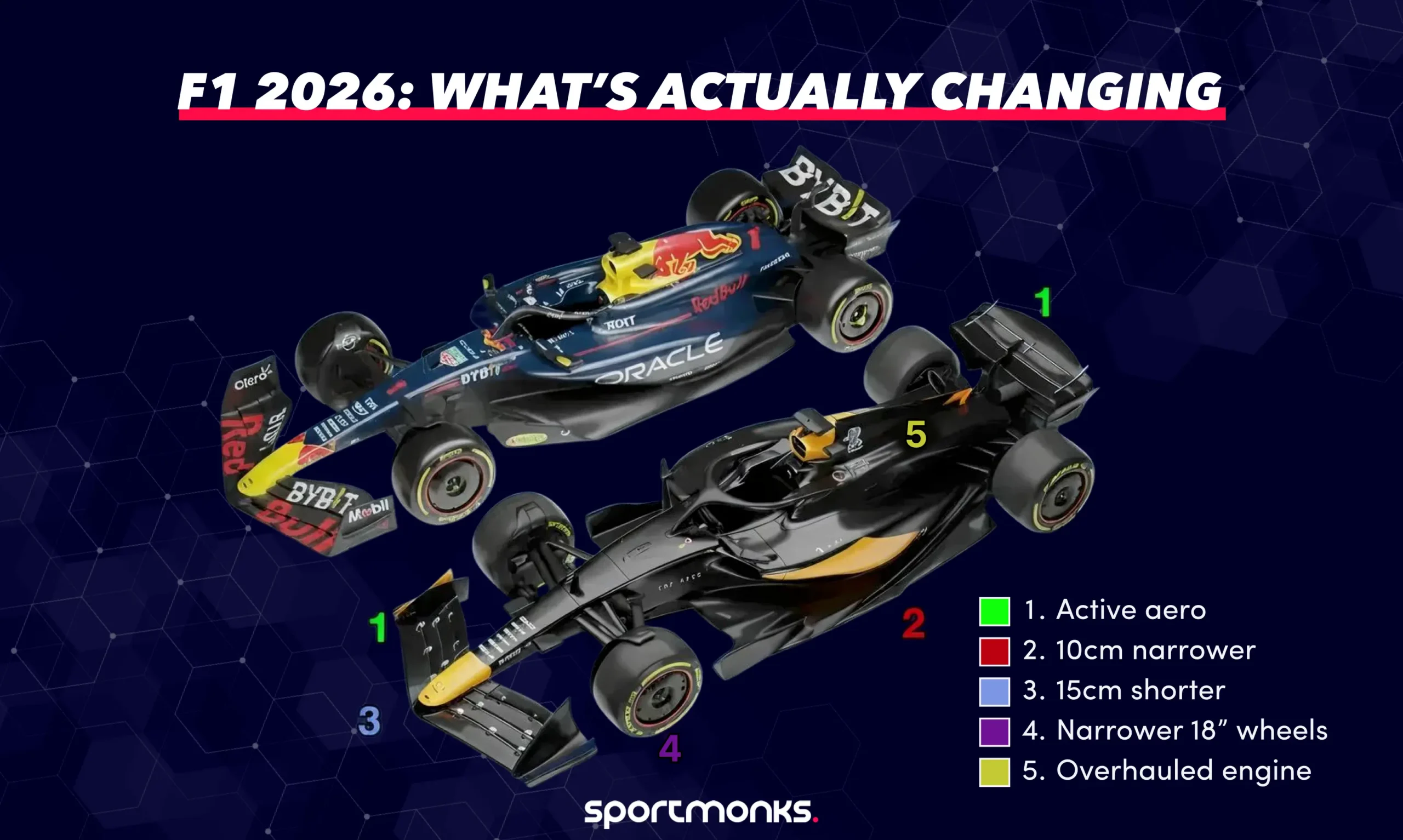
– Front tyres: 25mm narrower
– Rear tyres: 30mm narrower
This change reduces drag, cuts approximately 5kg from a full tyre set, and decreases overall grip, all contributing to the “nimble car” philosophy.
Design philosophy
The FIA’s “Nimble Car Concept” aims to create more agile, responsive machines that can change direction quickly and follow each other more closely. The reduced dimensions and weight should, in theory, improve wheel-to-wheel racing and make the cars more exciting to drive.
Aerodynamic revolution: Active aero replaces DRS
The end of DRS
From 2026, Formula 1 will discontinue the traditional Drag Reduction System (DRS) that has been used since 2011. Instead, cars will feature active aerodynamic systems with moveable elements on both the front and rear wings that can change configuration for different parts of a lap. This replaces the simple rear-wing DRS flap.
Active aerodynamic modes
Two Configurations
Under the 2026 rules, F1 cars will use two main aerodynamic states:
High-downforce mode
– Used in cornering phases when cars need grip.
– Wing elements are at a steeper angle to generate downforce.
Low-drag mode
– Used on straights to reduce aerodynamic resistance and improve top speed.
– Wing elements move to a more reclined position to cut drag.
These modes are functionally similar to the former DRS effect on speed, but they apply to both front- and rear-wing elements and are available to all drivers, not just when following within 1 second.
How this differs from DRS
Traditional DRS
– It could only be activated when a driver was within one second of the car ahead at a detection point.
– Only adjusted a flap on the rear wing.
– Designed mainly as an overtaking aid.
Active aero system
– It can be used by any driver regardless of proximity to others.
– Adjusts multiple wing elements for low drag or high downforce.
– Acts as a general aerodynamic tool rather than a pure overtaking assist.
Downforce and drag targets
The FIA’s aerodynamic targets:
– Downforce reduction: Approximately 15-30% compared to 2022-2025 cars
– Drag reduction: Up to 40-55% in Straight Mode
– Improved following: Cars retain 80% downforce at one car length (10 meters), 90% at two car lengths (20 meters)
Note: Initial FIA predictions suggested 40% downforce reduction, but this was revised to 15-30% after team feedback raised safety and performance concerns
Simplified wings and aerodynamic devices
Front wing
– Still present with active elements to allow high-downforce or low-drag states.
– Simplified compared with pre-2026 multi-element cascades under previous rules.
Rear wing
– Active elements replace the simple DRS flap concept.
– Designed to work in harmony with the front active aero to maintain aerodynamic balance.
Exact dimensions (e.g., specific millimetre narrowing or element counts) vary by team interpretation and development; regulatory texts focus on permitted ranges and functional requirements.
New overtaking systems: Overtake, Boost, and Recharge
The 2026 regulations introduce completely new terminology for how drivers deploy and recover electrical energy. Gone are the days of simply “opening DRS” or “pressing the overtake button.” The new systems are more strategic and complex.
Overtake mode (manual override mode)
Function: Replaces the performance advantage of DRS. While all cars use “X-Mode” (active aero) to reduce drag on straights, only the attacker gets this electrical boost.
How it works
– The trigger: Activated when a driver is within a specified distance of the car ahead (likely 1 second) at the detection point.
– The override: Standard power deployment “tapers off” (drops) starting at 290 km/h for the leading car. The Overtake Mode allows the chasing driver to override this taper, maintaining the full 350kW of power up to 337 km/h.
– The advantage: This creates a significant speed delta (difference) on long straights, as the car in front loses electrical push while the attacker keeps it.
– Energy management: While it allows for higher speeds, it still draws from the same MGU-K energy pool. Drivers must decide if the battery cost of the override is worth the potential pass.
What changed?
- The Name: Officially termed “Manual Override Mode” (MOM) in the regs.
- The “DRS” myth: Clarified that “opening the wing” (X-Mode) is now done by both cars; the electrical override is the actual tool for passing.
- The power curve: Corrected “extra 0.5 MJ” to the more accurate “Power Taper Override,” which is how the speed difference is actually generated.
Boost mode
Function: The standard energy deployment tool is available at any time
How it works:
– Driver-operated button on the steering wheel
– Deploys maximum power from the engine and battery combined
– Can be used offensively (attacking) or defensively (defending position)
– Available anywhere on track, not restricted to zones
– Limited only by available battery charge
Comparison to previous systems
Similar to the previous “overtake button” or KERS-style deployment, but with significantly more electrical power available (350kW vs. 120kW).
Recharge mode
Function: Actively harvesting electrical energy to recharge the battery
How it works
– Energy recovered under braking (primary source)
– Energy harvested by lifting off the throttle early (coasting into corners)
– Energy recovered during part-throttle corners.
– Can be managed automatically by the ECU or manually by the driver through the technique
Strategic importance
Drivers must balance aggressive energy deployment (using Boost and Overtake modes) with disciplined energy harvesting (Recharge) to maintain battery charge levels throughout the race. Running out of electrical energy leaves drivers vulnerable to attack.
Safety enhancements: Stronger structures, tougher tests
Improved crash protection
Roll hoop strengthening
– Increased load resistance from 16G to 20G impacts
– Equivalent to withstanding roughly nine family cars’ weight
– 23% more load-bearing capacity
Front impact structure redesign
– New two-stage nose design
– Separates into two distinct phases during impacts
– Addresses the previous issue where structures detached from the survival cell during initial impacts
– Provides better protection during secondary impacts after initial contact
Side protection enhancement
– More stringent side intrusion rules
– Doubled protection around the fuel cell area
– Improved structural integrity around the driver survival cell
Safety testing improvements
The driver survival cell undergoes more rigorous testing protocols, including higher loads and more comprehensive impact scenarios. These tests ensure the monocoque provides maximum protection across a wider range of accident types.
Visual safety features
ERS status lights
– New rear wing endplate lights
– Lateral safety lights on the car sides
– Indicate electrical system status.
– Help marshals and other drivers identify when cars have active electrical systems.
Heat hazard protocols
New regulations mandate driver cooling vests when the FIA declares a heat hazard (when the Heat Index is predicted to exceed 31.0°C). Previously optional, these redesigned cooling vests are now mandatory equipment during hot-weather races.
Following cars: Improved wheel-to-wheel racing
Dirty air reduction
The 2026 regulations specifically target the “dirty air” problem that makes following other cars difficult:
Wheel bodywork changes
– Front wheel arches eliminated
– In-wash boards added at sidepod fronts.
– Better control of wheel wake
Predicted performance when following
– 80% downforce retained at 10 meters (one car length behind)-
90% downforce retained at 20 meters (two car lengths behind)
Compare this to 2022-2025 cars, which lost significantly more downforce when following closely despite ground-effect regulations specifically designed to improve following.
More overtaking opportunities
The combination of factors should create more overtaking:
– Active Aero is available to all drivers (higher straight-line speeds)
– Overtake Mode provides a strategic energy boost.
– Better ability to follow closely through corners (less dirty air impact)
– Multiple deployment strategies create varied attack patterns.
Drivers like George Russell predict “overtakes in obscure locations, in locations where we’ve never seen overtakes before” as battery depletion and energy management create performance differentials at unexpected points around laps.
Six power unit manufacturers: Unprecedented competition
The 2026 regulations have successfully attracted massive automotive investment by removing the complex MGU-H, emphasising electrical power, and introducing 100% sustainable fuels. While six manufacturers were initially registered, the grid will feature five active suppliers in 2026, the most in the Turbo-Hybrid era.
Returning manufacturers
- Ferrari: Supplying Ferrari (works), Haas, and Cadillac (2026–2028).
- Mercedes: Supplying Mercedes (works), McLaren, Williams, and Alpine(Alpine officially shuttered its Renault engine program in 2024 to become a Mercedes customer).
- Honda: Returning as a full “works” partner after their soft exit, supplying Aston Martin (works) exclusively.
New entrants
- Red Bull Ford: Red Bull’s first in-house engine project (Red Bull Powertrains), developed in a technical partnership with Ford. Supplying Red Bull Racing (works) and Racing Bulls.
- Audi: Entering F1 for the first time by completing a full takeover of Sauber. Supplying Audi F1 Team (works).
- General Motors (2029): Officially approved by the FIA as a manufacturer for the 2029 season. Their brand, Cadillac, joins the grid as the 11th team in 2026 but will use Ferrari power units as a bridge until the GM engine is ready.
What stays the same
Not everything changes for 2026:
Unchanged elements
– 1.6-litre V6 engine: The “block” remains, but the architecture is vastly different. The MGU-H (Heat) is gone, and the MGU-K (Kinetic) now provides nearly 3x the power, 350KW vs 120KW.
– 18-inch wheel rims: While the rims stay the same size, the tyres are narrower (-25mm front, -30mm rear) and the overall tyre diameter has decreased slightly to save weight.
– Cost cap regulations: The cap has been adjusted to $215 million (up from ~$135 million). However, this isn’t a “spending spree”; the FIA included additional items in the cap (such as maternity leave and wellness costs) and adjusted for global inflation.
– Parc fermé & weekend format: These remain the same, including the standard six-event Sprint calendar.
Performance impact: slower or faster?
Lap time predictions
– The delta: Current data shows the cars are approximately 2 seconds per lap slower than peak 2025 speeds.
– The recovery: While they initially lost 30% of their downforce with the removal of ground-effect tunnels, teams have already “clawed back” much of this through front and rear wing optimisation.
– The trade-off: 2026 cars are slower in high-speed corners (like 130R at Suzuka) but significantly faster at the end of straights.
Top speed potential
– The 400 km/h barrier: You are spot on. Mercedes’ Toto Wolff famously predicted that 2026 cars would “scratch the 400 km/h (248mph) limit” on tracks like Monza or Las Vegas.
– Why? Because “X-Mode” (Active Aero) flattens both the front and rear wings, reducing drag by up to 40% compared to a 2025 car with DRS open. Combined with the massive electrical surge, the cars accelerate like “rockets” (as described by reserve driver Felipe Drugovich).
Development trajectory
– The “diet” is the biggest hurdle. The minimum weight is now 768kg (30kg lighter than 2025).
– Early-season development focuses on “Energy Clipping”; teams are learning to prevent the battery from running out of juice (de-rating) before the end of long straights.
Strategic complexity: The new variables
The 2026 Formula 1 season introduces major changes that make race strategy more complex, especially around energy systems, power deployment, aerodynamics, and sustainable fuel. Teams and drivers will have to work smarter with new tools that give them more decision-making power.
Energy management
Formula 1’s new rules mean electrical energy plays a much larger role in every lap and race decision. Drivers will need to consider:
– Battery state of charge and how it affects power deployment through a stint.
– Boost mode, which lets the driver deploy stored electrical energy anywhere on the track to attack or defend.
– Overtake mode, which replaces DRS, can be triggered only when within 1 second of the car ahead and grants extra energy for overtaking.
– Recharge, which is the intentional regeneration of electrical energy through braking and partial throttle.
– Energy deployment patterns that will influence tyre wear, race pace, and positioning decisions. This is now part of a driver’s strategy toolkit.
Team strategy considerations
– Strategic planning for 2026 will also take into account:
– Observing other teams’ energy use to predict their charge levels and likely tactics. While there are no direct data feeds, patterns in deployment give important clues.
– Circuit characteristics, since tracks with heavy braking or long straights change how much energy can be recovered.
– Race position, where attacking and defending demand different uses of Boost and Overtake Modes.
– Weather conditions, which naturally affect battery and fuel efficiency, though not a rule change, become more influential as reliance on electrical systems increases.
Fuel strategy implications
All teams will run advanced sustainable fuel from 2026 onwards. This introduces a new strategic element around fuel usage and power unit performance:
– Sustainable fuels are mandated for all cars and are part of F1’s long-term environmental goals.
– Manufacturers are likely to seek optimised fuel blends and engine calibration to extract every bit of usable energy, since the fuel’s chemical properties influence performance.
– Fuel flow limits are controlled by energy content rather than simple volume, meaning teams must strategically manage flow across a race.
– Decisions about fuel load and weight remain key to performance, balancing race range with car mass and battery demands.
Active aero tactics
Active aerodynamics replace the old DRS system and play into race strategy too:
– Active Aero allows drivers to switch between aerodynamic setups for straight-line efficiency or cornering grip at designated points on the circuit.
– Timing aero mode changes can save energy and improve overtaking chances by reducing drag or increasing downforce when it matters most.
– Changes to the aero configuration affect tyre temperatures and wear, which teams must factor into their stint planning.
The unknown factors
Despite detailed and comprehensive regulations for 2026, several important uncertainties remain as teams adapt to major technical changes in engines, fuels, and aerodynamic philosophy.
Reliability concerns
Entirely new power unit architecture and fresh participation by manufacturers introduce genuine uncertainty about reliability:
– Red Bull Ford Powertrains and Audi are building their first ground-up F1 power units under the new 2026 rules, alongside established manufacturers such as Mercedes, Ferrari, and Honda.
– Power units will see a much larger electrical component with MGU-K output increased significantly, changing how hybrid systems are balanced and potentially stressing components and electrical systems in new ways.
– All cars will run on 100% advanced, sustainable fuels for the first time in the sport’s history, which could demand unique calibration and thermal management strategies from engineers.
– Early running in pre-season testing showed some initial reliability issues for new engine programmes (e.g., Audi and Honda/Aston Martin), even as other manufacturers achieved strong mileage.
Competitive order shuffle
Major regulation changes have a strong history of reshaping the competitive pecking order in Formula 1:
– The arrival of new engine rules in 2014 allowed Mercedes to establish a period of dominance through superior hybrid integration.
– The major aerodynamic and regulatory reset in 2022 helped shift momentum toward Red Bull and Ferrari.
For 2026, teams face dual challenges: mastering both fundamentally new power unit architecture and new chassis/aerodynamic concepts. Those that optimise both elements quickly are most likely to lead, while teams that struggle with either area may fall behind.
Real-world following performance
While FIA simulations and wind-tunnel analysis provide structured predictions for closer racing and improved followability, true on-track dynamics remain an unknown until cars compete together:
– Different car designs may still produce varying wake patterns that affect how closely a following car can stay in turbulent air.
– Active aerodynamics and new aero philosophies could have unforeseen effects in wheel-to-wheel situations, as real airflow behaviour interacts with movable aero elements.
– Reductions in certain forms of downforce may make following easier in some scenarios, but could also change how lap time deltas behave in practice compared with models.
The ultimate test of following performance will come when the full grid runs together in competitive sessions, starting in Australia’s opening practice.
Why these changes matter
Road relevance
The 2026 regulations directly support automotive industry electrification:
– 50/50 hybrid split mirrors road car development trends
– Sustainable fuels applicable to existing vehicle fleets
– High-efficiency combustion research transfers to production engines.
– Electrical energy management systems inform EV development.
Manufacturers justify massive F1 investments by showcasing technologies applicable to their road car divisions.
Environmental goals
Formula 1 aims to achieve net-zero carbon emissions by 2030. The 2026 regulations support this through:
– 100% sustainable fuel, eliminating new fossil carbon
– Increased electrical power, reducing ICE dependency
– More efficient power units that extract maximum energy from minimal fuel
– While F1 cars themselves represent tiny global emissions, the technology development
and symbolic leadership drive broader automotive sustainability.
Competitive balance
– Removing the MGU-H’s complexity and cost lowers barriers for new manufacturers.
– Five competing power unit suppliers-Mercedes, Ferrari, Honda, Red Bull, Ford, and
– Audi theoretically prevents single-team domination and ensures competitive, unpredictable racing.
What this means for fans
More strategic racing
– Energy management creates new strategic dimensions beyond traditional tyre strategy.
– Drivers must think multiple laps ahead, balancing current position defence with future attack capabilities.
– Expect more radio communications about energy levels and deployment strategies.
Varied overtaking tactics
Overtake Mode’s flexibility means passes can happen anywhere, not just in DRS zones. A driver might deploy energy through multiple corners to stay alongside a rival, or save everything for one decisive straight-line attack. This unpredictability should create more exciting, varied racing.
Manufacturer battles
Five power unit manufacturers competing means multiple storylines:
– Can Red Bull Ford match established manufacturers?
– Will Honda’s return with Aston Martin challenge Mercedes and Ferrari?
– How quickly can Audi close the performance gap?
– These battles add layers beyond driver and team championships.
Learning curve
Fans will need to understand new terminology and systems:
– No more “DRS available” graphics
– New graphics showing Active Aero modes
– Energy deployment indicators
– Battery charge level displays
– Broadcasting will adapt to explain these systems, but expect a learning curve for casual users viewers.
Timeline: When changes take effect
Preseason testing
– January 26-30, 2026: Private test, Circuit de Barcelona-Catalunya (behind closed
doors, 5 days)
– February 11-13, 2026: Official preseason test, Bahrain International Circuit
– February 18-20, 2026: Official preseason test, Bahrain International Circuit
First race
– March 6-8, 2026: Australian Grand Prix, Albert Park Circuit, Melbourne
Development through season
– Teams will rapidly develop performance as they understand new regulations.
– Mid-season upgrades are likely to show significant gains.
– Expect competitive orders to evolve throughout the calendar.
Conclusion: F1’s biggest gamble
The 2026 regulations represent Formula 1’s most ambitious technical revolution since the hybrid era began in 2014. By simultaneously overhauling power units AND chassis regulations, the FIA has created maximum disruption and maximum opportunity.
The gamble
– Will sustainable fuels match conventional fuel performance?
– Can five manufacturers all produce competitive, reliable engines?
– Will Active Aero actually improve racing or create new problems?
– Can teams achieve the 770kg weight target with heavier power units?
The potential
– More overtaking through better following and strategic energy deployment.
– Closer competition through manufacturer variety
– Relevant technology development supporting automotive sustainability
– Exciting, unpredictable racing as teams master new systems
March 8, 2026, in Melbourne, will reveal whether this revolution delivers the promised racing or creates unforeseen challenges. One certainty exists: Formula 1 will look, sound, and race fundamentally differently than the sport has for the past four years.
The future of Grand Prix racing starts now.
Quick Reference: 2026 changes at a glance

Sportmonks and F1
Ready to power your F1 app or service with the most accurate and developer-friendly motorsport data available?
Explore the all-new Sportmonks Motorsport API today. Built for real-time race results, driver and team info, standings, lap times and more, it’s the best way to bring the 2026 F1 season’s revolution to your users or audience.
Get started with full docs and a free trial now and build something fans will love.
Frequently asked questions (FAQs)