
Contents
THE REAL COST OF FREE SPORTS DATA: WHAT NOBODY TELLS YOU
A free sports API sounds like the obvious starting point for any football data project. Zero upfront cost, no contract, no approval process. For a side project or proof of concept, it is hard to argue against. But when you are building something people will actually use, the free tier introduces a set of costs that do not appear on any invoice: your engineering time, your users’ frustration, and the opportunity cost of capabilities you cannot access. This guide walks through each hidden cost category, gives you a framework for calculating the true cost of ownership across different API options, and helps you decide which approach fits your actual build stage.
THE ILLUSION OF FREE: WHY TOTAL COST OF OWNERSHIP MATTERS
The sticker price of an API is one number. The total cost of ownership (TCO) is a different, larger number that includes: the time your team spends working around the API’s limitations, the revenue or user impact of the data gaps you cannot fill, the eventual cost of migration when the free tier no longer fits, and the ongoing cost of maintaining integrations that are not built to production standards.
A team that spends 40 hours engineering workarounds for a free API’s rate limits, data gaps, and unstable endpoints has spent more than the annual cost of a professional API plan, even before accounting for the opportunity cost of those 40 engineering hours.
Free tier pricing is not wrong or dishonest. It is a marketing mechanism, and it serves developers at the exploration stage well. The problem is treating it as a long-term infrastructure choice.
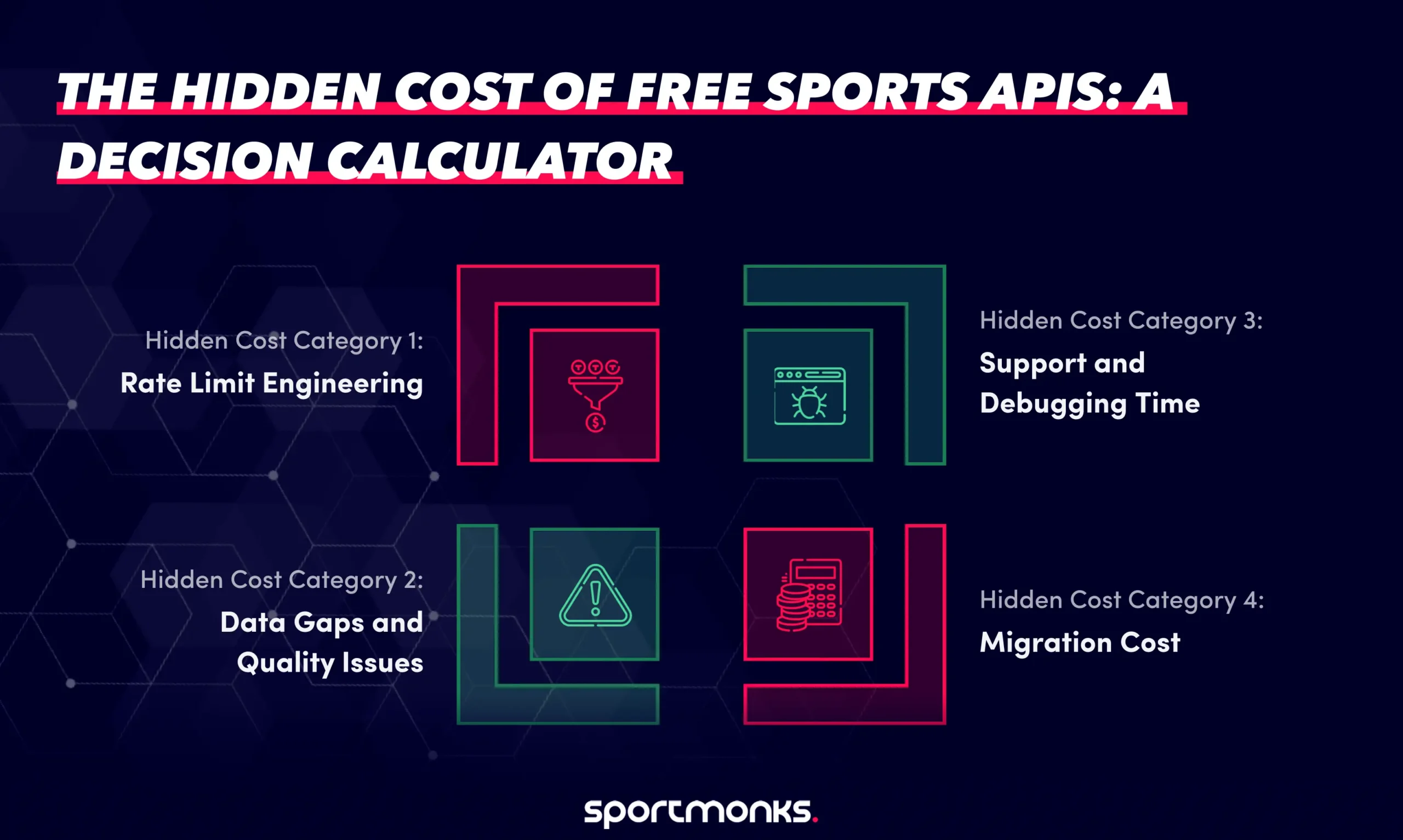
HIDDEN COST CATEGORY 1: RATE LIMIT ENGINEERING
Free and low-cost sports API tiers almost always come with rate limits: caps on how many requests you can make per minute, per hour, or per day. At the exploration stage, these limits are invisible. At production scale, they become a constant engineering problem.
What Rate Limit Engineering Looks Like
When you hit a rate limit in production, your application has to handle it gracefully. That means building: a request queue that spaces calls within the allowed window, retry logic with exponential back-off for failed requests, a cache layer that reduces the number of API calls by serving recently fetched data, and monitoring and alerting for when the queue backs up during peak traffic windows.
None of this is your product. It is infrastructure you are building to manage the limitations of your data source. An experienced developer can implement basic rate limit handling in a day. A production-grade version with proper monitoring, cache invalidation, and load-tested retry logic takes a week or more.
The cost of that week is a direct function of the rate limit on your free tier. It is a hidden cost that a free API’s price tag does not include.
Rate Limits and Live Match Windows
Rate limit constraints are most damaging during live match windows, precisely when your application needs to be most responsive. If your polling budget is exhausted because you over-fetched pre-match data, your live score widget goes stale exactly when your users are most engaged.
A plan with appropriate rate limits for your use case is not a premium you are paying for data. It is infrastructure reliability that eliminates an entire category of engineering problem.
HIDDEN COST CATEGORY 2: DATA GAPS AND QUALITY ISSUES
Free sports data tiers often carry coverage or quality limitations that are not obvious until you build against them.
Coverage Gaps
A free tier might cover major European leagues but not the 47 competitions your users care about. Or it covers all leagues but provides only final scores, not the event-by-event data you need for your live match centre. Or it has full historical data for the current season only, requiring you to source multi-season historical data from elsewhere.
Each coverage gap you discover mid-build adds scope: find an alternative source, evaluate its data format, build a second integration, maintain consistency between the two feeds.
A single data source with wide, consistent coverage is architecturally cleaner than two or three sources with overlapping, inconsistently structured data.
Data Quality and Consistency
Free and low-cost providers often have less rigorous data collection and quality control than professional-grade providers. Inconsistencies you might encounter include: player ID changes between seasons that break historical continuity, match result corrections that are not propagated to all endpoints, statistical figures that differ between the fixture endpoint and the player statistics endpoint, and league table calculations that do not match the official published standings.
Each inconsistency requires an engineering fix: validation logic, reconciliation routines, or manual overrides. These fixes accumulate into a maintenance burden that grows with your data breadth.
Null Data During Live Matches
Some free tier APIs throttle live event delivery during peak match windows. Events arrive late, in the wrong order, or not at all. You discover this in production, not in testing, because your test fixtures were in lower-demand periods. The fix is more engineering: event sequencing, deduplication, gap detection, and manual reconciliation after the final whistle.
HIDDEN COST CATEGORY 3: SUPPORT AND DEBUGGING TIME
When your API integration breaks in production at 20:45 on a Saturday (during a live match), how long does it take you to get a response?
With a free tier, the honest answer is: it might take days. Free API tiers typically offer self-service documentation and community forums. They do not offer direct support from engineers who know the API and can diagnose your specific issue.
The Cost of Downtime During Live Windows
A football data API that goes down for 30 minutes during a live match window causes measurable user impact. Users who cannot see live scores or match updates leave. Some do not come back. On a fan engagement or media platform, match windows are the highest-traffic periods in the entire week.
The cost of 30 minutes of data downtime during a live match window is not a maintenance annoyance. It is a user retention event.
Access to human support who can diagnose and respond to integration issues within minutes, not days, is not a luxury. It is the difference between a 30-minute outage and a 4-hour outage.
HIDDEN COST CATEGORY 4: MIGRATION COST
The free tier cannot scale indefinitely with your product. At some point, you will outgrow it: the rate limits will become inadequate, the data coverage will no longer match your competition list, the uptime will fall below what your users expect, or the provider will change the terms of the free tier.
When that happens, you face migration cost: evaluating alternatives, updating your integration to a new API’s data structures, testing the new integration, and potentially backfilling historical data from the new provider.
Migration is not a one-time cost. It consumes engineering time proportional to how deeply your application is coupled to the original API’s data structures. The more tightly you have built against a specific provider’s naming conventions, ID systems, and response shapes, the more expensive migration becomes.
Building against a professional-grade API with stable versioning and consistent data structures from the start reduces migration risk and migration cost if you ever do need to switch.
THE DECISION CALCULATOR: CHOOSING THE RIGHT API FOR YOUR BUILD STAGE
Use this framework to determine whether a free tier, a starter paid plan, or a professional plan is the right choice at your current stage.
Exploration Stage: A side project or proof of concept with no users yet
At exploration stage, a free tier is appropriate. You are learning the domain, testing data availability, and validating whether the concept is worth building. The hidden costs do not apply because you are not in production, you do not have users to disappoint, and engineering time spent on workarounds is part of the learning process.
Right choice: Free tier. Sign up, get an API token, build something small.
Early Product Stage: A working prototype with your first users
At this stage, you have users whose experience depends on your data. Rate limit constraints will affect your ability to serve them during live match windows. Data gaps will create holes in your product that users notice. Support response time matters because production issues now have user impact.
Right choice: Entry-level paid plan. The cost is low, the capability step up from a free tier is significant, and you eliminate the main hidden cost categories: engineering workarounds for rate limits and data gaps, plus access to support.
Growth Stage: A product with consistent users and commercial ambitions
At growth stage, data reliability is not a nice-to-have. Your revenue, your user retention, and your ability to sell to enterprise customers all depend on the quality and consistency of your data. Total cost of ownership now includes the cost of being down, the cost of bad data, and the cost of your users choosing a competitor whose product works during live match windows.
Right choice: A professional plan with the uptime guarantees, data depth, rate limits, and support model appropriate to your scale. The cost of the right plan at this stage is a rounding error compared to the cost of the hidden categories above.
WHAT PROFESSIONAL-GRADE LOOKS LIKE IN PRACTICE
The marks of a professional-grade sports data API are not features on a pricing page. They are the operational characteristics that eliminate the hidden cost categories:
Consistent uptime with a published track record. Sportmonks delivers 99.98% uptime across 6.4 billion requests per month, built over 10 years of production operation. That figure is not a marketing claim: it is the infrastructure baseline that your live match features depend on.
Rate limits that match production scale. Plans are structured around actual usage patterns, not arbitrary caps designed to create upgrade pressure. The limit at each tier corresponds to what you can actually build without engineering workarounds.
Human support, seven days per week. When your integration breaks at 20:45 on a Saturday, you can reach a person who knows the API and can help you diagnose the problem before the second half starts.
Wide coverage with consistent data structures. 2,350+ leagues on a single, stable API eliminates the multi-source integration problem. One integration, consistent data formats, across every competition you need.
Transparent pricing that starts at EUR 0. You can explore and validate without a credit card. The free tier is a genuine development environment, not a crippled demo. When you are ready for production, plans are priced 85% below the market median for professional-grade sports data. The cost of going professional is lower than most builders assume before they check.
View plans at https://sportmonks.com/football-api/plans-pricing/.
FAQ