Contents
WHAT IS AN SDK VS AN API WRAPPER?
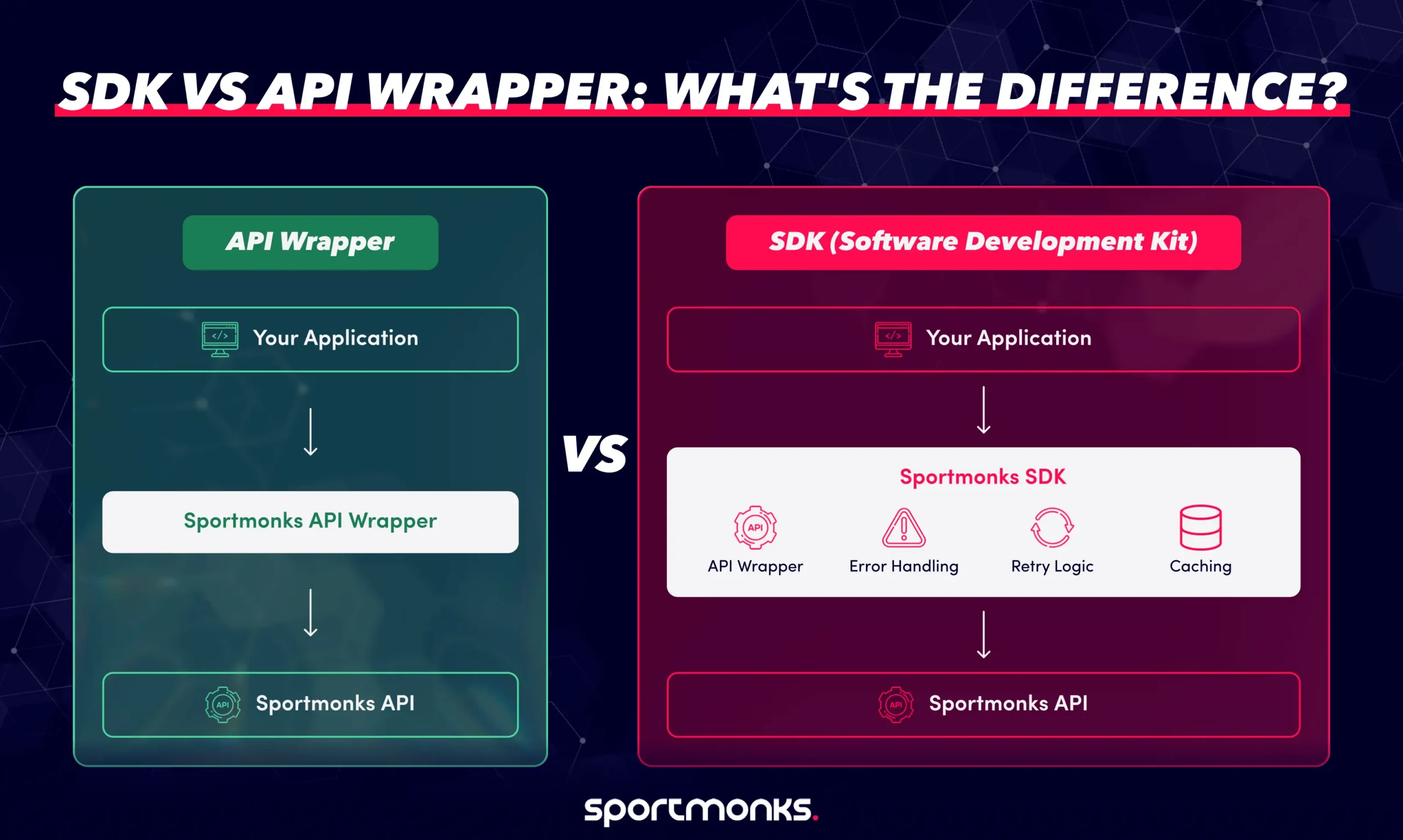
An SDK (Software Development Kit) and an API wrapper both help you integrate with an external service from your own code, but they serve different purposes. An API wrapper is a thin library that translates a raw HTTP API into native function calls in your language of choice, doing little more than handling authentication and serialising requests. An SDK is a broader toolkit: it typically includes the wrapper itself, plus helper utilities, error handling, retry logic, type definitions, code examples, and sometimes built-in caching or rate-limit management. When you integrate a sports data API, understanding which one you are reaching for determines how much boilerplate you write yourself.
HOW THEY DIFFER IN PRACTICE
An API wrapper does exactly what the name says: it wraps the API. You call a function in your language instead of constructing a raw HTTP request. The wrapper turns `GET /fixtures?league_id=501` into something like `client.fixtures.get(league_id=501)`. Authentication headers, base URL, and JSON parsing are handled for you. That is the full scope of what a wrapper offers.
An SDK starts where a wrapper ends. Beyond the HTTP abstraction, a well-built SDK gives you typed response models so your IDE autocompletes the fields that actually exist on a fixture object. It surfaces meaningful errors rather than raw HTTP status codes. It handles retry logic on transient failures. It may include pagination helpers so you never accidentally request 10,000 fixtures in a single call. Some SDKs bundle ready-made Postman collections, code examples for common workflows, or a local test harness. The goal is to reduce the distance between “I have an API key” and “I have working code in production.”
The distinction matters most when you are building under time pressure or with a small team. A wrapper saves you from writing HTTP boilerplate. An SDK saves you from writing the logic layer too.
WHEN AN API WRAPPER IS ENOUGH
A wrapper is the right tool when the API surface is small and predictable, your team is comfortable working close to the HTTP layer, and you want full control over how responses are handled. Internal tooling, quick prototypes, and personal projects are natural fits. If you are making a handful of requests to fetch match scores for a private dashboard, a wrapper gets you running in minutes with minimal overhead.
WHEN AN SDK ADDS REAL VALUE
An SDK earns its place when the API is large, the response shapes are complex, or reliability in production matters. For a sports data API that returns deeply nested fixture objects with 50+ optional fields, typed models eliminate an entire class of bugs. Retry logic with exponential backoff means a brief upstream spike does not cascade into a broken live score widget at 90+3 minutes. Pagination helpers mean you pull complete data sets without under- or over-fetching.
If your app is serving real users and your data feed is a dependency rather than a nice-to-have, an SDK is worth the additional setup. It shifts the maintenance burden off your team and onto the library maintainer.
SDK VS API WRAPPER: A PRACTICAL COMPARISON
Scope. A wrapper covers the HTTP transport layer. An SDK covers transport plus developer experience (types, errors, helpers, examples).
Setup time. A wrapper is typically lighter to install and configure. An SDK may have a larger footprint but pays back the setup time quickly on any non-trivial integration.
Error handling. A wrapper usually surfaces raw HTTP errors. An SDK translates them into structured exceptions your app can respond to meaningfully.
Type safety. Most wrappers return untyped dictionaries or generic JSON. SDKs for typed languages (TypeScript, Python with type hints, Go) provide typed models that catch field-access errors at compile time rather than runtime.
Maintenance. Wrappers are simpler to maintain and fork if you need custom behaviour. SDKs are more opinionated but save you from implementing patterns the API provider has already thought through.
SPORTS DATA APIs: WHICH SHOULD YOU REACH FOR?
With a football data API that exposes fixtures, standings, lineups, player stats, xG, Pressure Index, and live events across 2,500+ leagues, a bare wrapper leaves a lot of implementation work on your side: you will build your own retry logic, your own pagination loop, and your own model layer. An SDK absorbs that work and lets you move from API token to a working prototype in a single session. The 30,000+ sports builders using Sportmonks tend to ship faster when they start with the SDK rather than hand-rolling the request layer.
That said, if you are evaluating the API before committing, a wrapper is a perfectly valid starting point. Test the endpoints, understand the response shapes, and upgrade to the SDK once you are building something that will run in production.
FAQ