Contents
Tournament basics
The tournament began in 1957 with only three teams: Egypt, Sudan, and Ethiopia. Over the years, it has grown significantly and is now a major continental event featuring 24 teams in the final stages.
Growth & evolution
The format has changed considerably over the decades:
– Early years: Started with just 3 teams in 1957.
– 1962: Expanded to 4 teams.
– 1968-1990: Stabilised with 8 teams.
– 1992-1994: Grew to 12 teams.
– 1996-2017: Remained consistent with 16 teams.
– 2019 onwards: The format expanded to the current 24-team structure, which includes a group stage and a knockout round.
Qualification phase
Since 1962, the competition has had two main stages: a qualifying stage and the final tournament. The host nation, which for 2025 is Morocco, automatically qualifies. The qualification campaign for the 2025 edition involved 52 teams and took place in 2024.
Final tournament structure
The 2025 AFCON finals will be held in Morocco for the second time, with the first being in 1988. It’s scheduled to take place from 21 December 2025 to 18 January 2026. This is the first time the tournament will be held over the Christmas and New Year period. This change was due to scheduling conflicts with FIFA’s expanded Club World Cup. The tournament will use 9 venues across 6 cities in Morocco, including major stadiums in Rabat, Casablanca, Tangier, and Fez. The 24 qualified teams have been drawn into six groups of four. The top two teams from each group, along with the best four third-placed teams, will advance to the knockout stages, which begin with the round of 16.
Structure & format
The final tournament features 24 teams, drawn into six groups (A–F) of four teams each. They will compete in a round-robin format, where every team plays every other team in their group once.
From each group:
– The top two teams automatically go through to the round of 16.
– The four best third-placed teams from all six groups also qualify for the knockout stage.
Tiebreaker criteria (group stage)
When teams finish with the same number of points, the ranking is decided by the following CAF rules:
– Points obtained in the head-to-head matches among the tied teams.
– Goal difference in those head-to-head matches.
– Goals scored in those head-to-head matches.
– If more than two teams are tied, and after applying the above rules, two teams remain tied, the head-to-head rules are reapplied just between those two teams.
– Goal difference in all group matches.
– Goals scored in all group matches.
– The drawing of lots.
Knockout phase
The competition changes to a single-elimination format starting from the round of 16. Teams play in a single match, and the winner moves on, all the way through to the quarterfinals, semi-finals, third-place playoff, and eventually the final.
For matches that are level after 90 minutes (except for the third-place match):
– Extra time (two halves of 15 minutes each) is played.
– If the score is still level, the match is decided by a penalty shootout.
In the third-place playoff, if the match is a draw after 90 minutes, it goes straight to a penalty shootout without playing extra time.
History & records
Most successful nations
– Egypt stands as the most decorated team in Africa Cup of Nations history, with seven titles (1957, 1959, 1986, 1998, 2006, 2008, and 2010).
– Cameroon follows with five titles, marking them as the second-most successful nation.
– Ghana has claimed the championship four times (1963, 1965, 1978, 1982).
Other notable champions include:
– Nigeria with three titles,
– Ivory Coast, DR Congo, and Algeria each with two titles,
– Morocco, Tunisia, Sudan, Senegal, Ethiopia,, and South Africa each with one title.
Memorable winners & recent champions
– The 2023 AFCON final, held in Abidjan on February 11, 2024, saw Ivory Coast triumph over Nigeria with a 2–1 scoreline, earning their third title.
– As of the 2023 edition, Ivory Coast are the current title holders.
Record appearances & legacy
– Egypt also leads in longevity, holding the record for the most tournament appearances (25) and final appearances (10).
– Among individual players, Ahmed Hassan (Egypt) and Essam El‑Hadary (Egypt) have both featured in the most AFCON finals (4 each).
Additional notable records
– The longest penalty shootout in AFCON history occurred in the 2006 final, when Ivory Coast edged out Cameroon in a dramatic 12–11 shootout following a 1–1 draw.
– The most goals scored in a single tournament:
– 54 goals during the eight‑team 1974 edition in Egypt,
– 99 goals in the 16‑team 2008 edition in Ghana
– 119 goals in the 24‑team 2023 edition in Ivory Coast.
– The highest single-match attendance reached 120,000 spectators during the 1986 Egypt vs. Cameroon clash in Cairo; the highest overall tournament attendance recorded was about 735,000 in 1980.
Trivia & culture
National team nicknames
Every AFCON team has a nickname that is full of cultural, historical, or symbolic meaning. These nicknames often come from the country’s national wildlife, heritage, or identity and help with team branding and fan passion. Examples from the 2023 tournament include:
– Ivory Coast – “The Elephants”: Symbolising grace and strength, this name is inspired by the country’s historical ivory trade and its large elephant population.
– Nigeria – “Super Eagles”: This reflects pride, courage, and ambition. The name comes from the eagle on the Nigerian coat of arms.
– Algeria – “The Fennec Foxes”: Named after the native desert fox, this nickname represents agility and survival.
– Zambia – “Chipolopolo” (copper bullets): This symbolises speed and resilience, reflecting the nation’s copper mining heritage.
Rivalries & cultural showdowns
The “Jollof Derby” (Nigeria vs. Ghana): This fierce rivalry is named after the popular jollof rice dish, which creates a friendly competition between the two nations over who makes it best. It is one of the most watched rivalries in African football and reflects deep-rooted cultural, economic, and historical ties between the two countries.
Official theme & cultural expression
“Akwaba” (welcome): This song by Magic System featuring Yemi Alade and Mohamed Ramadan was the official anthem of AFCON 2023. It beautifully blends African unity with music and serves as a vibrant cultural focal point for fans.
Emerging branding: Pamoja AFCON
“Pamoja,” meaning “together” in Swahili, is the brand identity for the joint bid by Kenya, Uganda, and Tanzania to co-host AFCON 2027. This brand emphasises regional unity and co-operation, and it will be the first time three East African nations will host the tournament together. It also shows CAF’s encouragement of collaborative hosting models.
Related CAF tournaments
National teams & youth competitions
The Confederation of African Football (CAF) organises a range of tournaments in addition to the Africa Cup of Nations:
– African Nations Championship (CHAN): A tournament held every two years that only features players from domestic leagues. It provides valuable exposure for locally based talent. CHAN 2025 will be hosted jointly by Kenya, Uganda, and Tanzania and is scheduled for February 1–28, 2025.
– U-17 Africa Cup of Nations: A biennial competition that showcases the continent’s top under-17 national teams. The latest edition took place in Morocco from March 30 to April 19, 2025, with the hosts crowned champions after a nervous penalty shootout with Mali.
– U-20 Africa Cup of Nations: A biennial youth tournament that recently concluded in Egypt, running from April 27 to May 18, 2025 with South Africa crowned champions after defeating Morocco 1-0.
– Women’s Africa Cup of Nations (WAFCON): The premier tournament for women’s national teams. After being postponed from its original 2024 date, the edition hosted in Morocco was held in July 2025.
– CAF U-17 Girls Integrated Football Tournament (GIFT): The CAF U-17 Girls Integrated Football Tournament (GIFT) is an annual club-level competition for girls under 17. The inaugural edition took place in Dar es Salaam, Tanzania, in January 2025. JKT Queens were crowned the champions after a 2-1 victory over fellow Tanzanian side TDS Girls in the final.
– CAF African School Football Championship: A grassroots-level tournament that aims to promote youth football development through schools.
Club competitions
CAF’s structure for club football includes multiple prestigious competitions:
– CAF Champions League: The highest level of club football in Africa, similar to UEFA’s Champions League. It features top clubs from across CAF and the winner gets to play in the FIFA Club World Cup.
– CAF Confederation Cup: The second-tier club competition, created in 2004 from a merger of the CAF Cup and African Cup Winners’ Cup. The winners play the Champions League holder in the CAF Super Cup.
– CAF Super Cup: A one-off match between the winners of the Champions League and the Confederation Cup.
Other variants & emerging formats
– Futsal Africa Cup of Nations: CAF organises a continental tournament for futsal teams, which is a fast-paced, indoor version of football.
– African Football League: A new inter-club competition intended to improve club football. It is used in CAF’s club rankings and new club competition structures.
Sportmonks’ role in African sports
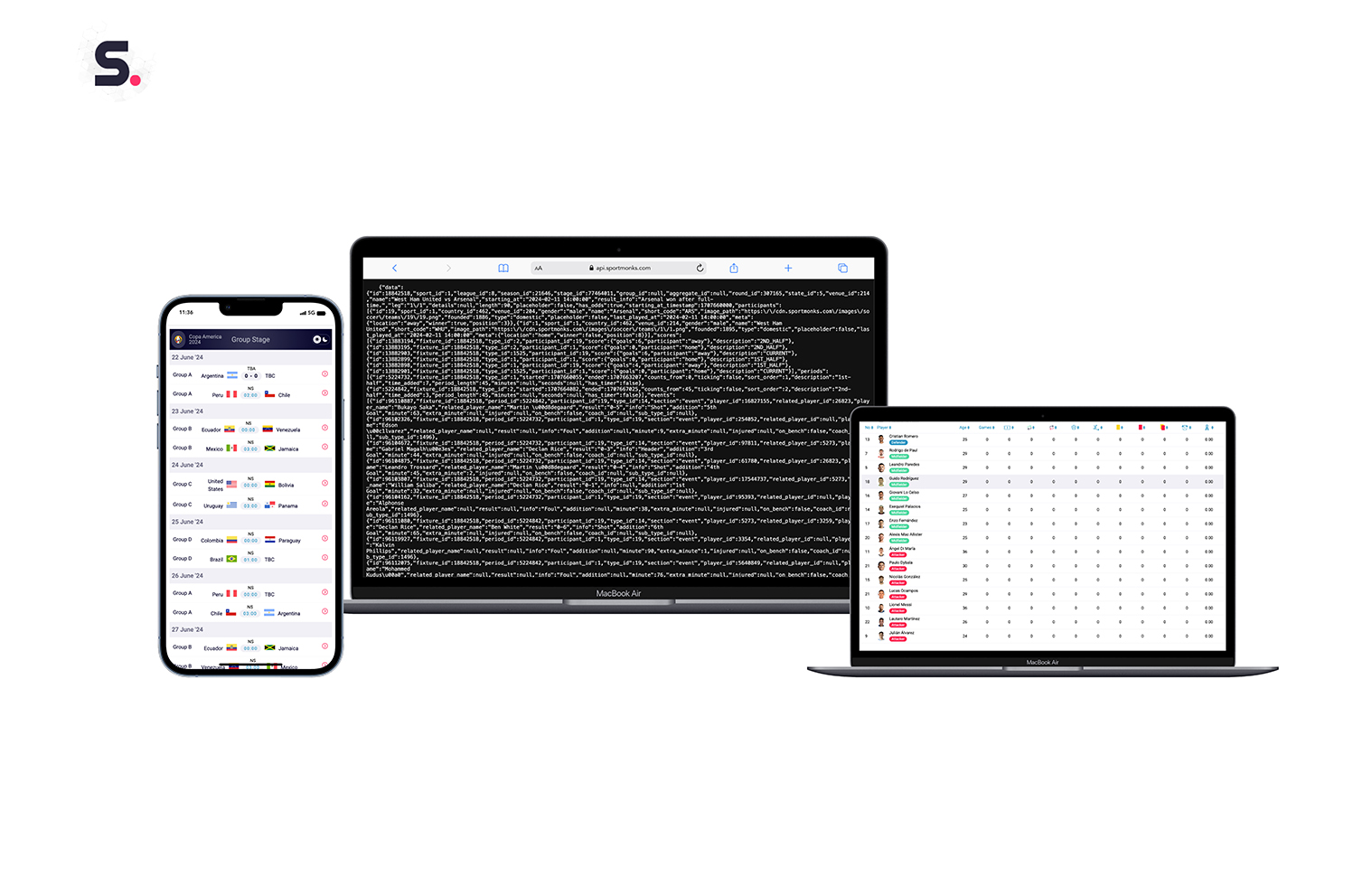
Sportmonks’ Football API provides detailed, real-time football data for tournaments like AFCON. This includes match schedules, historical results, live scores, team line-ups, stats, league tables, betting odds, and even coach and referee data.
The AFCON Football API is a dedicated part of Sportmonks’ broader Football API, designed specifically for the tournament. It offers live and historical match data, formations, and predictive insights.
API 3.0 has introduced advanced, high-quality data capabilities, such as ball position tracking, predictive line-ups, detailed player positions, referee statistics, and richer event data. These features improve the detail and usefulness of AFCON content.
Sportmonks ensures that developers can easily integrate their data. They provide comprehensive documentation through GitBook, along with tutorials, guides, filters, demo response files, and Postman-ready examples. This makes getting smooth access to AFCON data simple and easy.
Power your AFCON coverage with Sportmonks
The Africa Cup of Nations 2025 is set to light up Morocco, and fans around the world will be watching every moment. With Sportmonks’ football API, you get live scores, detailed match stats, line-ups, and predictive insights, all tailored for African football. Whether you’re building a betting platform, fan hub, or analytics tool, our reliable data gives you the edge.
Start using Sportmonks today and make your AFCON content stand out.
Facts about the Afcon